Ch.12 Alcohols, Thiols, Ethers, Aldehydes, and Ketones
Timberlake - Chemistry: An Introduction to General, Organic, and Biological Chemistry 13th Edition
Timberlake13th EditionChemistry: An Introduction to General, Organic, and Biological ChemistryISBN: 9780134421353Non è quello che usi tu?Cambia libro di testo
Capitolo 12, Problema 68

Compound X is a secondary alcohol whose formula is C3H8O. When compound X is heated with strong acid, it dehydrates to form compound Y (C3H6). When compound X is oxidized, compound Z (C3H6O) forms, which cannot be oxidized further. Draw the condensed structural formulas and give the IUPAC names for compounds X, Y, and Z.

Guida verificata passo dopo passo
1
Step 1: Identify the structure of compound X. Since compound X is a secondary alcohol with the formula C₃H₈O, it must have a hydroxyl group (-OH) attached to a secondary carbon. The possible structure is 2-propanol (CH₃-CHOH-CH₃).
Step 2: Determine the dehydration reaction. When 2-propanol is heated with a strong acid, it undergoes a dehydration reaction (loss of water) to form an alkene. The product, compound Y, is propene (CH₃-CH=CH₂).
Step 3: Analyze the oxidation of compound X. When 2-propanol is oxidized, the secondary alcohol is converted into a ketone. The product, compound Z, is acetone (CH₃-CO-CH₃), which has the formula C₃H₆O.
Step 4: Confirm that compound Z cannot be oxidized further. Ketones, such as acetone, do not undergo further oxidation under normal conditions because there is no hydrogen atom attached to the carbonyl carbon.
Step 5: Summarize the IUPAC names and condensed structural formulas. Compound X is 2-propanol (CH₃-CHOH-CH₃), compound Y is propene (CH₃-CH=CH₂), and compound Z is acetone (CH₃-CO-CH₃).

Risposta video verificata per un problema simile:

Questa soluzione video è stata consigliata dai nostri tutor come utile per risolvere questo problema.

Concetti chiave

Ecco i concetti essenziali che devi comprendere per rispondere correttamente alla domanda.

Secondary Alcohols

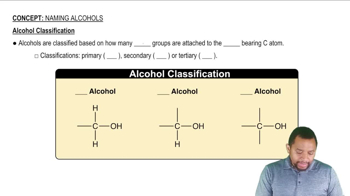
Secondary alcohols are organic compounds where the hydroxyl (-OH) group is attached to a carbon atom that is itself connected to two other carbon atoms. This structure influences their reactivity, particularly in dehydration and oxidation reactions. In the case of compound X (C₃H₈O), it is a secondary alcohol, which means it can undergo dehydration to form an alkene and oxidation to form a ketone.
Video consigliato:
Percorso guidato
1:10
Alcohol Classification Concept 2

Dehydration Reaction

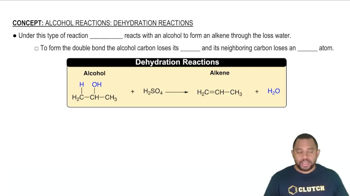
A dehydration reaction involves the removal of a water molecule from a compound, often resulting in the formation of a double bond. In this scenario, when compound X is heated with strong acid, it loses a water molecule to form compound Y (C₃H₆), an alkene. This reaction is a common method for converting alcohols into alkenes and is facilitated by acidic conditions.
Video consigliato:
Percorso guidato
1:30
Alcohol Reactions: Dehydration Reactions Concept 1

Oxidation of Alcohols

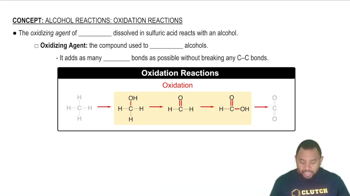
Oxidation of alcohols refers to the chemical process where alcohols are converted into carbonyl compounds, such as aldehydes or ketones, by the addition of oxygen or the removal of hydrogen. In this case, when compound X is oxidized, it forms compound Z (C₃H₆O), which is a ketone. The fact that compound Z cannot be oxidized further indicates that it is a stable product, typically characteristic of ketones.
Video consigliato:
Percorso guidato
1:49
Alcohol Reactions: Oxidation Concept 1