Ch.12 Alcohols, Thiols, Ethers, Aldehydes, and Ketones
Timberlake - Chemistry: An Introduction to General, Organic, and Biological Chemistry 13th Edition
Timberlake13th EditionChemistry: An Introduction to General, Organic, and Biological ChemistryISBN: 9780134421353Non è quello che usi tu?Cambia libro di testo
Capitolo 12, Problema 34a

Draw the condensed structural formula for the alcohol formed when each of the following is reduced by hydrogen in the presence of a nickel catalyst:
a. ethyl propyl ketone

Guida verificata passo dopo passo
1
Identify the functional group in ethyl propyl ketone. It contains a ketone group (C=O), which is a carbonyl group bonded to two alkyl groups: ethyl (CH3CH2-) and propyl (CH3CH2CH2-).
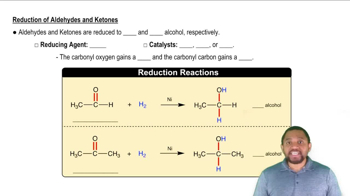
Understand the reduction process. When a ketone is reduced by hydrogen (H2) in the presence of a nickel catalyst, the carbonyl group (C=O) is converted into a hydroxyl group (-OH), forming an alcohol.
Determine the location of the carbonyl group in ethyl propyl ketone. The ketone group is located on the second carbon of the propyl chain, making the compound 2-pentanone.
Replace the carbonyl group (C=O) with a hydroxyl group (-OH) at the same position (second carbon of the propyl chain). This forms the alcohol corresponding to 2-pentanone, which is 2-pentanol.
Write the condensed structural formula for the alcohol. The structure will be CH3CH2CHOHCH2CH3, where the hydroxyl group (-OH) is attached to the second carbon of the pentane chain.

Risposta video verificata per un problema simile:

Questa soluzione video è stata consigliata dai nostri tutor come utile per risolvere questo problema.

Concetti chiave

Ecco i concetti essenziali che devi comprendere per rispondere correttamente alla domanda.

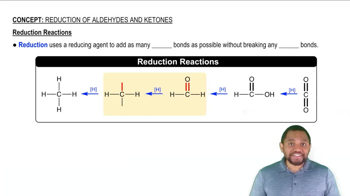
Reduction Reaction

A reduction reaction involves the gain of electrons or hydrogen by a molecule, often resulting in the conversion of a carbonyl group (C=O) to an alcohol (C-OH). In this context, the reduction of ethyl propyl ketone will yield an alcohol by adding hydrogen across the carbonyl bond.
Video consigliato:
Percorso guidato
2:38
Reduction Reactions Concept 1

Nickel Catalyst

A nickel catalyst is a substance that accelerates the rate of a chemical reaction without being consumed in the process. In hydrogenation reactions, nickel is commonly used to facilitate the addition of hydrogen to unsaturated compounds, such as ketones, making it essential for the reduction of ethyl propyl ketone to its corresponding alcohol.
Video consigliato:
Percorso guidato
1:57
Reduction of Aldehydes and Ketones Concept 2

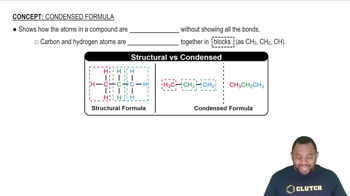
Condensed Structural Formula

A condensed structural formula is a way of representing a chemical structure that shows the arrangement of atoms in a molecule without depicting all the bonds explicitly. It provides a simplified view of the molecule, indicating how atoms are grouped together, which is crucial for identifying the resulting alcohol from the reduction of ethyl propyl ketone.
Video consigliato:
Percorso guidato
1:53
Condensed Formula Concept 1