Ch.12 Alcohols, Thiols, Ethers, Aldehydes, and Ketones
Timberlake - Chemistry: An Introduction to General, Organic, and Biological Chemistry 13th Edition
Timberlake13th EditionChemistry: An Introduction to General, Organic, and Biological ChemistryISBN: 9780134421353Non è quello che usi tu?Cambia libro di testo
Capitolo 12, Problema 3b

Draw the condensed structural formula, or line-angle formula if cyclic, for each of the following:
b. 3-pentanethiol

Guida verificata passo dopo passo
1
Step 1: Understand the name of the compound. The name '3-pentanethiol' indicates that the compound is a thiol (contains an -SH group) and has a five-carbon chain (pentane) as the parent structure. The '3-' indicates that the -SH group is attached to the third carbon in the chain.
Step 2: Draw the backbone of the molecule. Start with a straight chain of five carbon atoms (pentane). Represent this as: CH3-CH2-CH2-CH2-CH3.
Step 3: Place the -SH group on the third carbon atom. Replace one of the hydrogens on the third carbon with the -SH group. The structure now becomes: CH3-CH2-CH(SH)-CH2-CH3.
Step 4: Verify the structure. Ensure that each carbon atom has four bonds and that the -SH group is correctly placed on the third carbon.
Step 5: If needed, convert the condensed structural formula into a line-angle formula. For a line-angle formula, represent the carbon chain as a zigzag line with the -SH group attached to the third vertex. Each vertex represents a carbon atom, and hydrogens are implied unless otherwise specified.

Risposta video verificata per un problema simile:

Questa soluzione video è stata consigliata dai nostri tutor come utile per risolvere questo problema.

Concetti chiave

Ecco i concetti essenziali che devi comprendere per rispondere correttamente alla domanda.

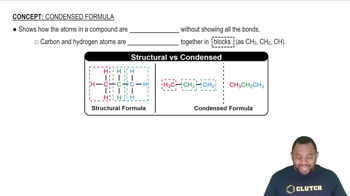
Condensed Structural Formula

A condensed structural formula is a way of representing a chemical compound that shows the arrangement of atoms and the connectivity between them without depicting all the bonds explicitly. In this format, groups of atoms are often grouped together to simplify the representation, making it easier to visualize the molecular structure. For example, in 3-pentanethiol, the condensed formula would indicate the presence of a thiol (-SH) group attached to the third carbon of a five-carbon chain.
Video consigliato:
Percorso guidato
1:53
Condensed Formula Concept 1

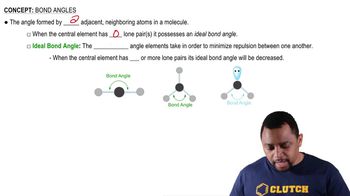
Line-Angle Formula

The line-angle formula, also known as the skeletal formula, is a shorthand representation of organic molecules where vertices represent carbon atoms and lines represent bonds. This method omits hydrogen atoms attached to carbons, making it easier to visualize larger and more complex structures. For cyclic compounds, this format is particularly useful as it clearly shows the ring structure and connectivity without cluttering the diagram with unnecessary details.
Video consigliato:
Percorso guidato
01:24
Bond Angles (Simplified) Concept 1

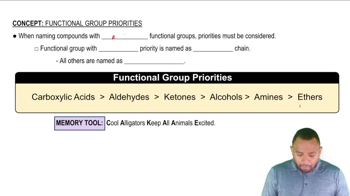
Functional Groups

Functional groups are specific groups of atoms within molecules that are responsible for the characteristic chemical reactions of those molecules. In the case of 3-pentanethiol, the functional group is the thiol group (-SH), which imparts unique properties such as odor and reactivity. Understanding functional groups is essential for predicting the behavior of organic compounds and for drawing their structural representations accurately.
Video consigliato:
Percorso guidato
1:11
Functional Group Priorities Concept 1