Ch.12 Alcohols, Thiols, Ethers, Aldehydes, and Ketones
Timberlake - Chemistry: An Introduction to General, Organic, and Biological Chemistry 13th Edition
Timberlake13th EditionChemistry: An Introduction to General, Organic, and Biological ChemistryISBN: 9780134421353Non è quello che usi tu?Cambia libro di testo
Capitolo 12, Problema 64

Draw the condensed structural formulas and give the IUPAC names for all the aldehydes and ketones that have the formula C5H10O. (12.3)

Guida verificata passo dopo passo
1
Step 1: Understand the molecular formula C₅H₁₀O. This formula indicates that the compound contains 5 carbon atoms, 10 hydrogen atoms, and 1 oxygen atom. Since the compound is specified to be an aldehyde or ketone, the oxygen atom is part of a carbonyl group (C=O). Aldehydes have the carbonyl group at the end of the carbon chain, while ketones have it within the chain.
Step 2: Begin with aldehydes. For aldehydes, the carbonyl group is at the terminal position. Draw all possible linear and branched structures with the carbonyl group at the end of the chain. Ensure the total number of carbons is 5 and the total number of hydrogens is 10. Write the condensed structural formulas for each structure.
Step 3: Name the aldehydes using IUPAC nomenclature. Identify the longest continuous carbon chain that includes the carbonyl group, number the chain starting from the carbonyl carbon, and use the suffix '-al' to indicate an aldehyde. For branched structures, identify and name the substituents, and include their positions in the name.
Step 4: Move to ketones. For ketones, the carbonyl group is within the chain. Draw all possible linear and branched structures where the carbonyl group is not at the terminal position. Again, ensure the total number of carbons is 5 and the total number of hydrogens is 10. Write the condensed structural formulas for each structure.
Step 5: Name the ketones using IUPAC nomenclature. Identify the longest continuous carbon chain that includes the carbonyl group, number the chain starting from the end closest to the carbonyl group, and use the suffix '-one' to indicate a ketone. For branched structures, identify and name the substituents, and include their positions in the name.

Risposta video verificata per un problema simile:

Questa soluzione video è stata consigliata dai nostri tutor come utile per risolvere questo problema.

Concetti chiave

Ecco i concetti essenziali che devi comprendere per rispondere correttamente alla domanda.

Aldehydes

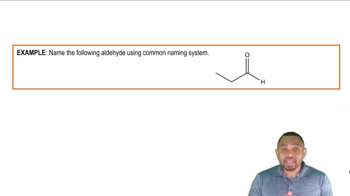
Aldehydes are organic compounds characterized by the presence of a carbonyl group (C=O) at the end of a carbon chain. The general formula for aldehydes is RCHO, where R represents a hydrocarbon group. In the case of C₅H₁₀O, the aldehyde will have a terminal carbonyl group, influencing its structural representation and IUPAC naming.
Video consigliato:
Percorso guidato
0:34
Naming Aldehydes Example 2

Ketones

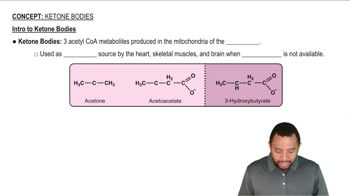
Ketones are organic compounds that contain a carbonyl group (C=O) located within the carbon chain, specifically between two carbon atoms. The general formula for ketones is RC(=O)R', where R and R' are hydrocarbon groups. For the formula C₅H₁₀O, the ketones will have the carbonyl group situated in various positions, affecting their structural formulas and IUPAC names.
Video consigliato:
Percorso guidato
1:29
Ketone Bodies Concept 1

IUPAC Nomenclature

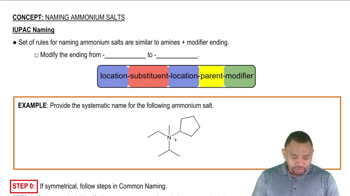
IUPAC nomenclature is a systematic method for naming chemical compounds, ensuring that each compound has a unique and descriptive name. For aldehydes and ketones, the naming involves identifying the longest carbon chain containing the functional group, followed by suffixes like '-al' for aldehydes and '-one' for ketones. Understanding this nomenclature is essential for accurately naming the compounds derived from the molecular formula C₅H₁₀O.
Video consigliato:
Percorso guidato
3:18
IUPAC Naming Concept 3