Ch.12 Alcohols, Thiols, Ethers, Aldehydes, and Ketones
Timberlake - Chemistry: An Introduction to General, Organic, and Biological Chemistry 13th Edition
Timberlake13th EditionChemistry: An Introduction to General, Organic, and Biological ChemistryISBN: 9780134421353Non è quello che usi tu?Cambia libro di testo
Capitolo 12, Problema 29d

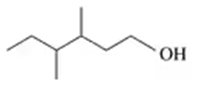
Draw the condensed structural or line-angle formula for the aldehyde or ketone formed when each of the following alcohols is oxidized [O] (if no reaction, write none):
d.

Guida verificata passo dopo passo
1
Identify the type of alcohol in the given structure (primary, secondary, or tertiary). Primary alcohols oxidize to aldehydes, secondary alcohols oxidize to ketones, and tertiary alcohols generally do not undergo oxidation under mild conditions.
Examine the structure of the alcohol provided in the image to determine the classification of the alcohol based on the carbon atom to which the hydroxyl (-OH) group is attached.
If the alcohol is primary, remove two hydrogen atoms: one from the hydroxyl group and one from the carbon atom bonded to the hydroxyl group. This forms a double bond between the carbon and oxygen, resulting in an aldehyde.
If the alcohol is secondary, remove two hydrogen atoms: one from the hydroxyl group and one from the carbon atom bonded to the hydroxyl group. This forms a double bond between the carbon and oxygen, resulting in a ketone.
If the alcohol is tertiary, note that no reaction occurs under typical oxidation conditions because there is no hydrogen atom on the carbon bonded to the hydroxyl group to facilitate the oxidation process.

Risposta video verificata per un problema simile:

Questa soluzione video è stata consigliata dai nostri tutor come utile per risolvere questo problema.

Concetti chiave

Ecco i concetti essenziali che devi comprendere per rispondere correttamente alla domanda.

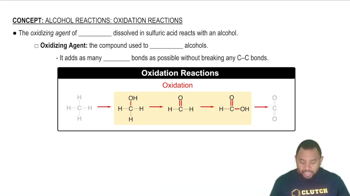
Oxidation of Alcohols

Oxidation of alcohols involves the conversion of alcohols into carbonyl compounds, such as aldehydes or ketones, through the removal of hydrogen atoms or the addition of oxygen. Primary alcohols typically oxidize to aldehydes, while secondary alcohols oxidize to ketones. This process is often facilitated by oxidizing agents like potassium dichromate or PCC.
Video consigliato:
Percorso guidato
1:49
Alcohol Reactions: Oxidation Concept 1

Aldehydes and Ketones

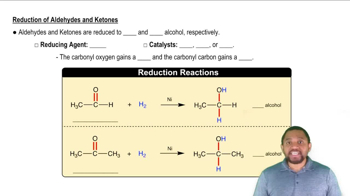
Aldehydes and ketones are both types of carbonyl compounds characterized by the presence of a carbonyl group (C=O). Aldehydes have the carbonyl group at the end of the carbon chain, while ketones have it within the chain. Their structural formulas are crucial for understanding their reactivity and properties, as they influence the types of reactions these compounds can undergo.
Video consigliato:
Percorso guidato
1:57
Reduction of Aldehydes and Ketones Concept 2

Condensed Structural and Line-Angle Formulas

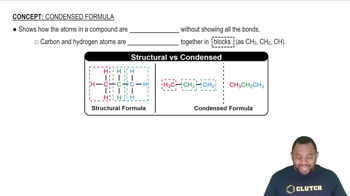
Condensed structural formulas provide a simplified representation of a molecule, showing the arrangement of atoms without depicting all bonds explicitly. Line-angle formulas, on the other hand, use lines to represent bonds and vertices to represent carbon atoms, making it easier to visualize complex organic structures. Both methods are essential for conveying the structure of organic compounds efficiently.
Video consigliato:
Percorso guidato
1:53
Condensed Formula Concept 1