Ch.12 Alcohols, Thiols, Ethers, Aldehydes, and Ketones
Timberlake - Chemistry: An Introduction to General, Organic, and Biological Chemistry 13th Edition
Timberlake13th EditionChemistry: An Introduction to General, Organic, and Biological ChemistryISBN: 9780134421353Non è quello che usi tu?Cambia libro di testo
Capitolo 12, Problema 50c

Which compound in each pair would be more soluble in water? Explain.
c. methyl propyl ether or 1-butanol

Guida verificata passo dopo passo
1
Identify the key factors that influence solubility in water: Water is a polar solvent, so compounds that can form hydrogen bonds with water or have polar functional groups are generally more soluble.
Analyze the structure of methyl propyl ether: This compound contains an ether functional group (-O-) but lacks hydroxyl (-OH) groups, which limits its ability to form hydrogen bonds with water. Its solubility in water is primarily due to the oxygen atom's lone pairs, which can weakly interact with water molecules.
Analyze the structure of 1-butanol: This compound contains a hydroxyl (-OH) group, which can form strong hydrogen bonds with water molecules. This significantly enhances its solubility in water compared to compounds without hydroxyl groups.
Compare the two compounds: While both compounds have some ability to interact with water, 1-butanol's hydroxyl group allows it to form stronger and more extensive hydrogen bonding with water than the ether group in methyl propyl ether.
Conclude: Based on the ability to form hydrogen bonds, 1-butanol would be more soluble in water than methyl propyl ether.

Risposta video verificata per un problema simile:

Questa soluzione video è stata consigliata dai nostri tutor come utile per risolvere questo problema.

Concetti chiave

Ecco i concetti essenziali che devi comprendere per rispondere correttamente alla domanda.

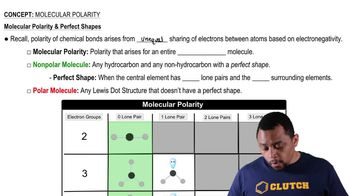
Polarity

Polarity refers to the distribution of electrical charge over the atoms in a molecule. Polar molecules, which have a significant difference in electronegativity between their atoms, tend to interact well with water, a polar solvent. In contrast, nonpolar molecules do not dissolve well in water due to their lack of charge separation.
Video consigliato:
Percorso guidato
01:34
Molecular Polarity (Simplified) Concept 1

Hydrogen Bonding

Hydrogen bonding is a type of strong intermolecular attraction that occurs when hydrogen is bonded to highly electronegative atoms like oxygen or nitrogen. In the context of solubility, compounds that can form hydrogen bonds with water, such as alcohols, are generally more soluble than those that cannot, as these interactions help to stabilize the solute in the solvent.
Video consigliato:
Percorso guidato
1:22
Hydrogenation Reactions Concept 1

Functional Groups

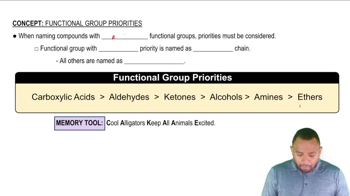
Functional groups are specific groups of atoms within molecules that are responsible for the characteristic chemical reactions of those molecules. In the case of the compounds in the question, the presence of the hydroxyl (-OH) group in 1-butanol enhances its solubility in water compared to methyl propyl ether, which lacks this polar functional group.
Video consigliato:
Percorso guidato
1:11
Functional Group Priorities Concept 1