Ch.13 Carbohydrates
Timberlake - Chemistry: An Introduction to General, Organic, and Biological Chemistry 13th Edition
Timberlake13th EditionChemistry: An Introduction to General, Organic, and Biological ChemistryISBN: 9780134421353Non è quello che usi tu?Cambia libro di testo
Capitolo 13, Problema 69b

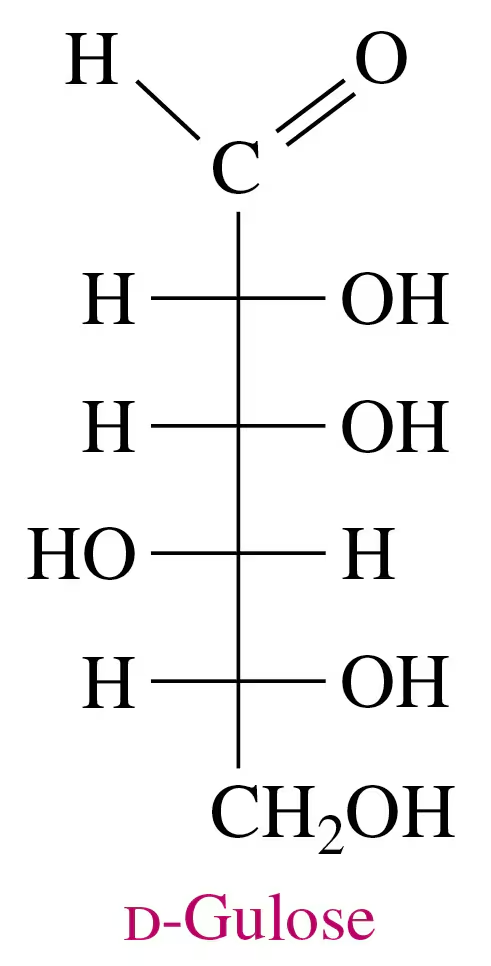
The sugar d-gulose is a sweet-tasting syrup.
Haworth structure of d-gulose, a sweet syrup, showing its cyclic monosaccharide form.
b. Draw the Haworth structures for α− and β-D-gulose.

Guida verificata passo dopo passo
1
Understand that d-gulose is a monosaccharide, specifically an aldohexose, meaning it contains six carbon atoms and an aldehyde functional group. The Haworth structure represents the cyclic form of the sugar, which forms when the aldehyde group reacts with a hydroxyl group on the same molecule to create a hemiacetal.
Identify the key components of d-gulose: the aldehyde group at the top (C1) and the hydroxyl groups attached to the other carbons. The stereochemistry of d-gulose determines the orientation of these hydroxyl groups. For d-gulose, the hydroxyl groups on C2 and C4 are on the right in the Fischer projection, while the hydroxyl group on C3 is on the left.
To draw the Haworth structure, first form a six-membered ring (a pyranose) by connecting the oxygen of the hydroxyl group on C5 to the carbon of the aldehyde group (C1). This creates a new chiral center at C1, leading to two possible anomers: α and β.
For the α-anomer, place the hydroxyl group on C1 (the anomeric carbon) pointing downward (opposite to the CH2OH group on C5). For the β-anomer, place the hydroxyl group on C1 pointing upward (same side as the CH2OH group on C5).
Complete the structure by ensuring the correct orientation of the hydroxyl groups on C2, C3, and C4 based on the stereochemistry of d-gulose. The CH2OH group on C5 should always point upward in the d-configuration. Label the structures as α-d-gulose and β-d-gulose accordingly.

Risposta video verificata per un problema simile:

Questa soluzione video è stata consigliata dai nostri tutor come utile per risolvere questo problema.
Durata del video:
3m

Concetti chiave

Ecco i concetti essenziali che devi comprendere per rispondere correttamente alla domanda.

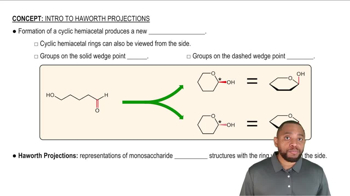
Haworth Structure

The Haworth structure is a way of representing the cyclic form of monosaccharides, where the sugar is depicted in a ring form. This representation highlights the anomeric carbon, which is the carbon that was part of the carbonyl group in the open-chain form. The orientation of the hydroxyl groups around this carbon determines whether the sugar is in the alpha (α) or beta (β) configuration.
Video consigliato:
Percorso guidato
2:18
Intro to Haworth Projections Concept 1

Anomeric Carbon

The anomeric carbon is the carbon atom in a sugar that was part of the carbonyl group (aldehyde or ketone) before the sugar cyclizes. In the case of d-gulose, this carbon is crucial for determining the sugar's anomeric form. The configuration of the hydroxyl group attached to the anomeric carbon defines whether the sugar is in the α or β form, influencing its chemical properties and reactivity.
Video consigliato:
Percorso guidato
5:36
Amino Acid Catabolism: Carbon Atoms Concept 2

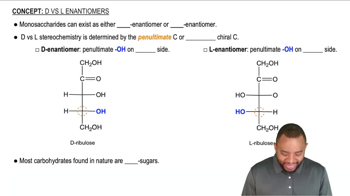
D- and L- Configuration

The D- and L- configuration refers to the stereochemistry of sugars based on the orientation of the hydroxyl group on the penultimate carbon (the second-to-last carbon). In d-gulose, the 'D' designation indicates that the hydroxyl group on this carbon is on the right side in the Fischer projection. This configuration is essential for distinguishing between different sugars and understanding their biochemical roles.
Video consigliato:
Percorso guidato
1:30
D vs L Enantiomers Concept 1