Ch.13 Carbohydrates
Timberlake - Chemistry: An Introduction to General, Organic, and Biological Chemistry 13th Edition
Timberlake13th EditionChemistry: An Introduction to General, Organic, and Biological ChemistryISBN: 9780134421353Non è quello che usi tu?Cambia libro di testo
Capitolo 13, Problema 59a

What are the disaccharides and polysaccharides present in each of the following?
a. <IMAGE>

Guida verificata passo dopo passo
1
Identify the disaccharides and polysaccharides by analyzing the structure in the provided image. Look for glycosidic bonds, which are the linkages between monosaccharide units.
Determine the monosaccharides present in the structure. Common monosaccharides include glucose, fructose, and galactose. These will help identify the disaccharide or polysaccharide.
For disaccharides, check if the structure contains two monosaccharide units joined by a glycosidic bond. Examples of disaccharides include sucrose, lactose, and maltose.
For polysaccharides, observe if the structure contains multiple monosaccharide units linked together. Examples of polysaccharides include starch, glycogen, and cellulose.
Match the identified disaccharides or polysaccharides to their common names based on the structural features and glycosidic linkages observed in the image.

Risposta video verificata per un problema simile:

Questa soluzione video è stata consigliata dai nostri tutor come utile per risolvere questo problema.
Durata del video:
1m

Concetti chiave

Ecco i concetti essenziali che devi comprendere per rispondere correttamente alla domanda.

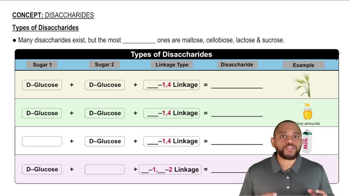
Disaccharides

Disaccharides are carbohydrates formed by the combination of two monosaccharide molecules through a glycosidic bond. Common examples include sucrose (glucose + fructose), lactose (glucose + galactose), and maltose (glucose + glucose). They serve as important energy sources and are found in various foods, playing a crucial role in nutrition.
Video consigliato:
Percorso guidato
3:39
Types of Disaccharides Concept 1

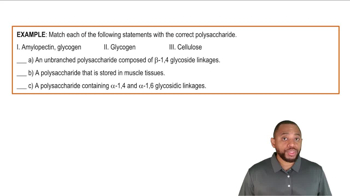
Polysaccharides

Polysaccharides are complex carbohydrates composed of long chains of monosaccharide units linked together. They can be classified into storage polysaccharides, like starch and glycogen, and structural polysaccharides, such as cellulose and chitin. These molecules are vital for energy storage and providing structural support in plants and animals.
Video consigliato:
Percorso guidato
1:24
Polysaccharides Example 1

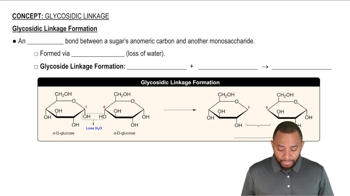
Glycosidic Bonds

Glycosidic bonds are covalent linkages formed between monosaccharides during the synthesis of disaccharides and polysaccharides. This bond is created through a dehydration reaction, where a water molecule is released. The type and position of glycosidic bonds influence the properties and digestibility of the resulting carbohydrate.
Video consigliato:
Percorso guidato
1:44
Glycosidic Linkage Formation Concept 1