Ch.14 Carboxylic Acids, Esters, Amines, and Amides
Timberlake - Chemistry: An Introduction to General, Organic, and Biological Chemistry 13th Edition
Timberlake13th EditionChemistry: An Introduction to General, Organic, and Biological ChemistryISBN: 9780134421353Non è quello che usi tu?Cambia libro di testo
Capitolo 14, Problema 44c

Draw the condensed structural formula for each of the following amides:
c. 3-methylbutyramide

Guida verificata passo dopo passo
1
Step 1: Understand the structure of the parent compound. The name '3-methylbutyramide' indicates that the parent compound is butyramide, which is derived from butanoic acid (a four-carbon carboxylic acid). The '-amide' suffix means the carboxylic acid group (-COOH) is replaced by an amide group (-CONH2).
Step 2: Identify the substituent. The '3-methyl' prefix indicates that there is a methyl group (-CH3) attached to the third carbon of the butyramide chain. Number the carbon chain starting from the carbon in the amide group to locate the third carbon.
Step 3: Write the backbone structure. Begin with the amide group (-CONH2) attached to the first carbon. Then, add three more carbons in a straight chain to complete the four-carbon backbone of butyramide.
Step 4: Add the substituent. Attach the methyl group (-CH3) to the third carbon of the chain, as specified by the name '3-methylbutyramide.'
Step 5: Combine all components into the condensed structural formula. Write the structure in a condensed format, showing the amide group, the main chain, and the substituent. For example, the condensed formula will look like CH3-CH(CH3)-CH2-CONH2.

Risposta video verificata per un problema simile:

Questa soluzione video è stata consigliata dai nostri tutor come utile per risolvere questo problema.
Durata del video:
2m

Concetti chiave

Ecco i concetti essenziali che devi comprendere per rispondere correttamente alla domanda.

Amides

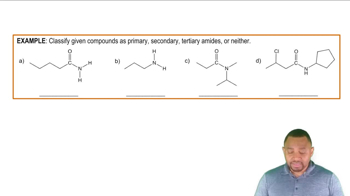
Amides are organic compounds derived from carboxylic acids where the hydroxyl group is replaced by an amine or ammonia. They have the general structure R-CO-NR'R'', where R represents a hydrocarbon chain, and NR'R'' indicates the nitrogen atom bonded to one or more alkyl or aryl groups. Amides are important in various biological processes and are commonly found in proteins.
Video consigliato:
Percorso guidato
1:03
Intro to Amides Example 1

Condensed Structural Formula

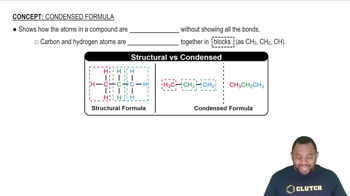
A condensed structural formula is a way of representing a chemical structure that shows the arrangement of atoms in a molecule without depicting all the bonds explicitly. It typically groups atoms together to indicate how they are connected, making it easier to visualize the molecular structure. For example, in the case of amides, the carbonyl (C=O) and amine (N-H) groups are highlighted in the formula.
Video consigliato:
Percorso guidato
1:53
Condensed Formula Concept 1

3-Methylbutyramide

3-Methylbutyramide is a specific amide derived from 3-methylbutanoic acid. Its structure includes a butane chain with a methyl group on the third carbon, and the amide functional group (-C(=O)NR2) attached to the terminal carbon. Understanding its structure is essential for drawing its condensed formula, which will reflect the arrangement of the carbon chain and the amide group.
Video consigliato:
Percorso guidato
0:52
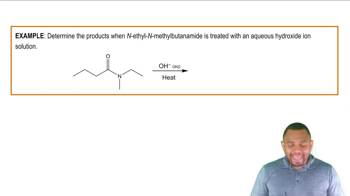
Basic Hydrolysis Example 2