Ch.14 Carboxylic Acids, Esters, Amines, and Amides
Timberlake - Chemistry: An Introduction to General, Organic, and Biological Chemistry 13th Edition
Timberlake13th EditionChemistry: An Introduction to General, Organic, and Biological ChemistryISBN: 9780134421353Non è quello che usi tu?Cambia libro di testo
Capitolo 14, Problema 80e

Ethyl octanoate is a flavor component of mangoes.
<IMAGE>
e. How many milliliters of a 0.315 M NaOH solution is needed to completely hydrolyze (saponify) 2.84 g of ethyl octanoate?

Guida verificata passo dopo passo
1
Step 1: Write the balanced chemical equation for the hydrolysis (saponification) reaction. Ethyl octanoate (C10H20O2) reacts with NaOH to produce ethanol (C2H5OH) and sodium octanoate (C8H15O2Na). The reaction is: C1020O2 + NaOH → C25OH + C815O2Na.
Step 2: Calculate the molar mass of ethyl octanoate (C10H20O2). Add the atomic masses of all the atoms in the molecule: Carbon (C) = 12.01 g/mol, Hydrogen (H) = 1.008 g/mol, and Oxygen (O) = 16.00 g/mol. The molar mass is: (10 × 12.01) + (20 × 1.008) + (2 × 16.00) g/mol.
Step 3: Determine the number of moles of ethyl octanoate in 2.84 g. Use the formula: massmolar mass. Substitute the given mass (2.84 g) and the molar mass calculated in Step 2.
Step 4: Use the stoichiometry of the reaction to find the moles of NaOH required. From the balanced equation, the molar ratio of ethyl octanoate to NaOH is 1:1. Therefore, the moles of NaOH required are equal to the moles of ethyl octanoate calculated in Step 3.
Step 5: Calculate the volume of 0.315 M NaOH solution needed. Use the formula: moles of solutemolarity. Substitute the moles of NaOH (from Step 4) and the molarity of the NaOH solution (0.315 M). Convert the result to milliliters (1 L = 1000 mL).

Risposta video verificata per un problema simile:

Questa soluzione video è stata consigliata dai nostri tutor come utile per risolvere questo problema.
Durata del video:
5m

Concetti chiave

Ecco i concetti essenziali che devi comprendere per rispondere correttamente alla domanda.

Saponification Reaction

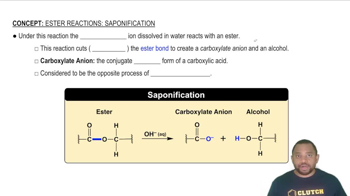
Saponification is a chemical reaction between a fat or oil and a base, typically sodium hydroxide (NaOH), resulting in the formation of glycerol and soap. In this context, ethyl octanoate, an ester, undergoes hydrolysis in the presence of NaOH to produce octanoic acid and ethanol. Understanding this reaction is crucial for calculating the amount of NaOH needed for complete hydrolysis.
Video consigliato:
Percorso guidato
1:25
Ester Reactions: Saponification Concept 1

Molarity (M)

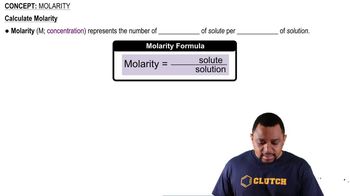
Molarity is a measure of concentration defined as the number of moles of solute per liter of solution. In this problem, the NaOH solution has a molarity of 0.315 M, indicating that there are 0.315 moles of NaOH in every liter of solution. This concept is essential for determining how much volume of the NaOH solution is required to react with the given mass of ethyl octanoate.
Video consigliato:

Stoichiometry

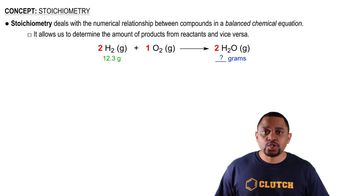
Stoichiometry involves the calculation of reactants and products in chemical reactions based on balanced equations. To solve the problem, one must first determine the moles of ethyl octanoate from its mass and then use the stoichiometric coefficients from the saponification reaction to find the corresponding moles of NaOH needed. This concept is fundamental for accurately calculating the volume of NaOH required.
Video consigliato: