Ch.14 Carboxylic Acids, Esters, Amines, and Amides
Timberlake - Chemistry: An Introduction to General, Organic, and Biological Chemistry 13th Edition
Timberlake13th EditionChemistry: An Introduction to General, Organic, and Biological ChemistryISBN: 9780134421353Non è quello che usi tu?Cambia libro di testo
Capitolo 14, Problema 35a

Indicate if each of the following is soluble in water. Explain.
a. Structural formula of propylamine, showing CH3-CH2-NH2, indicating its chemical composition.

Guida verificata passo dopo passo
1
Step 1: Understand the concept of solubility in water. Solubility depends on the chemical nature of the substance and water. Water is a polar solvent, so substances that are polar or ionic tend to dissolve in water due to the 'like dissolves like' principle.
Step 2: Identify the chemical structure or formula of the substance in the image provided. If the substance is ionic (e.g., salts like NaCl) or contains polar functional groups (e.g., -OH, -NH2), it is likely to be soluble in water.
Step 3: Check for the presence of nonpolar groups (e.g., long hydrocarbon chains) in the substance. If the molecule is predominantly nonpolar, it is less likely to dissolve in water.
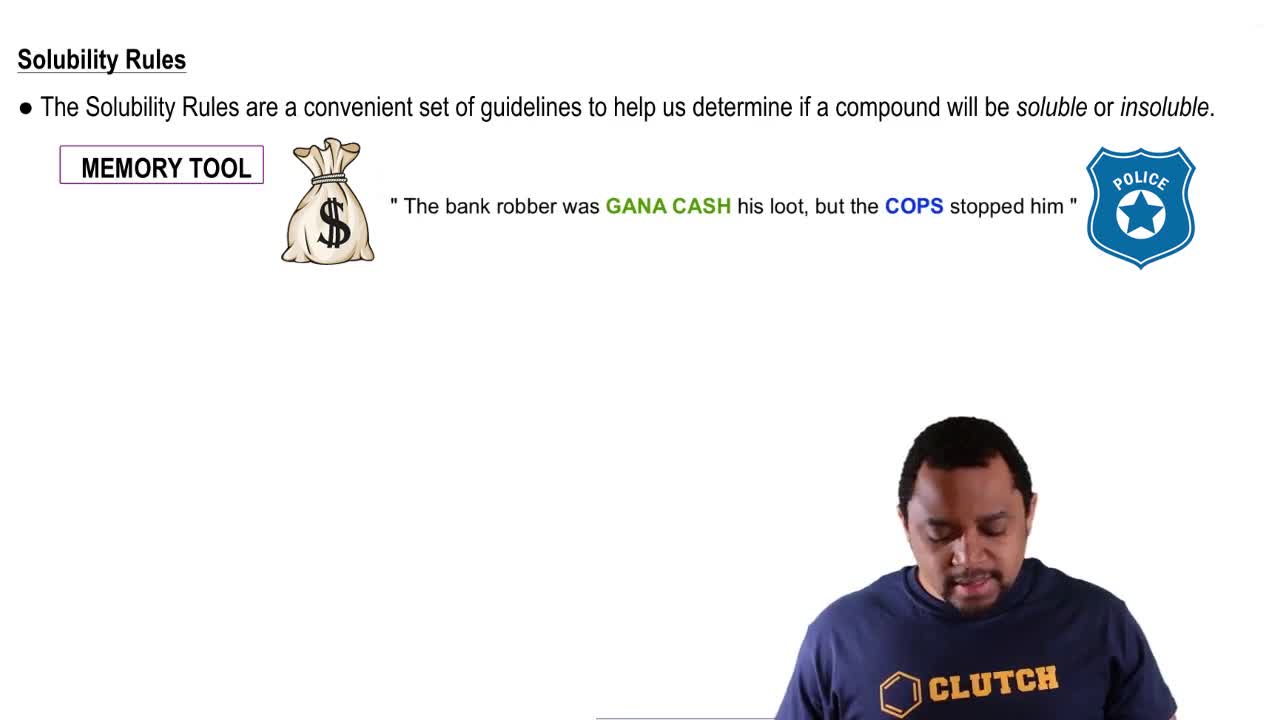
Step 4: Consider any solubility rules for ionic compounds. For example, most nitrates (NO3-) and alkali metal salts are soluble in water, while some compounds like AgCl are not.
Step 5: Based on the analysis of the chemical structure and solubility rules, determine whether the substance is soluble in water and explain your reasoning clearly.

Risposta video verificata per un problema simile:

Questa soluzione video è stata consigliata dai nostri tutor come utile per risolvere questo problema.
Durata del video:
3m

Concetti chiave

Ecco i concetti essenziali che devi comprendere per rispondere correttamente alla domanda.

Solubility

Solubility refers to the ability of a substance to dissolve in a solvent, typically water. It is influenced by factors such as temperature, pressure, and the nature of the solute and solvent. Polar substances tend to dissolve well in polar solvents like water, while non-polar substances do not. Understanding solubility is crucial for predicting how substances interact in aqueous solutions.
Video consigliato:
Percorso guidato
00:28
Solubility Rules

Polarity

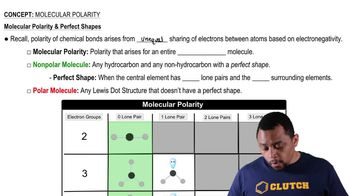
Polarity is a property of molecules that describes the distribution of electrical charge. Molecules with a significant difference in electronegativity between atoms exhibit polar characteristics, leading to partial positive and negative charges. Water is a polar molecule, which allows it to effectively dissolve other polar substances, while non-polar molecules remain insoluble. Recognizing polarity helps in determining solubility.
Video consigliato:
Percorso guidato
01:34
Molecular Polarity (Simplified) Concept 1

Ionic and Molecular Compounds

Ionic compounds are formed from the electrostatic attraction between positively and negatively charged ions, while molecular compounds consist of molecules formed by covalent bonds. Ionic compounds generally dissolve in water due to their ability to dissociate into ions, whereas molecular compounds may or may not dissolve depending on their polarity. Understanding the nature of these compounds is essential for predicting their solubility in water.
Video consigliato:
Percorso guidato
02:11
Naming Ionic Compounds