Ch.14 Carboxylic Acids, Esters, Amines, and Amides
Timberlake - Chemistry: An Introduction to General, Organic, and Biological Chemistry 13th Edition
Timberlake13th EditionChemistry: An Introduction to General, Organic, and Biological ChemistryISBN: 9780134421353Non è quello che usi tu?Cambia libro di testo
Capitolo 14, Problema 66a

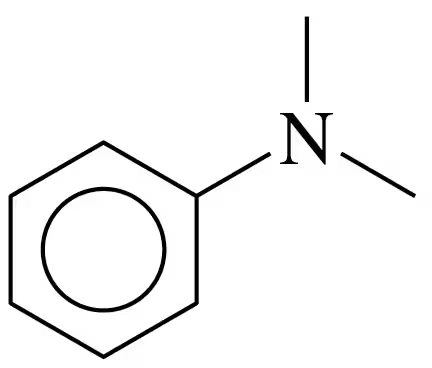
Write the common name and classify each of the following compounds as primary (1°), secondary (2°), or tertiary (3°): (14.5)
a. Chemical structure of an amine with a benzene ring and a nitrogen atom, illustrating its molecular configuration.

Guida verificata passo dopo passo
1
Step 1: Understand the classification of amines. Amines are classified as primary (1°), secondary (2°), or tertiary (3°) based on the number of alkyl or aryl groups attached to the nitrogen atom. A primary amine has one alkyl/aryl group, a secondary amine has two, and a tertiary amine has three.
Step 2: Examine the structure of the compound in the image provided. Identify the nitrogen atom and count the number of alkyl or aryl groups directly attached to it.
Step 3: Determine the common name of the compound. The common name of an amine is typically derived by naming the alkyl groups attached to the nitrogen atom in alphabetical order, followed by the word 'amine.'
Step 4: Based on the number of alkyl or aryl groups attached to the nitrogen atom, classify the compound as primary (1°), secondary (2°), or tertiary (3°).
Step 5: Verify your classification and naming by cross-referencing with standard naming conventions and classification rules for amines.

Risposta video verificata per un problema simile:

Questa soluzione video è stata consigliata dai nostri tutor come utile per risolvere questo problema.
Durata del video:
1m

Concetti chiave

Ecco i concetti essenziali che devi comprendere per rispondere correttamente alla domanda.

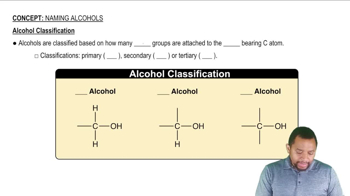
Classification of Alcohols

Alcohols are classified based on the number of carbon atoms attached to the carbon bearing the hydroxyl (-OH) group. A primary (1°) alcohol has one carbon atom attached to the carbon with the -OH group, a secondary (2°) alcohol has two, and a tertiary (3°) alcohol has three. This classification is crucial for understanding the reactivity and properties of alcohols in organic chemistry.
Video consigliato:
Percorso guidato
1:10
Alcohol Classification Concept 2

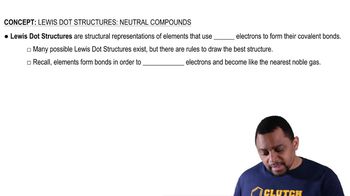
Structural Representation of Compounds

Understanding how to read and interpret structural formulas is essential for classifying compounds. Structural representations, such as Lewis structures or skeletal formulas, show the arrangement of atoms and bonds in a molecule. This visual information helps in identifying functional groups and determining the classification of alcohols based on their structure.
Video consigliato:
Percorso guidato
00:37
Lewis Dot Structures: Neutral Compounds (Simplified) Concept 1

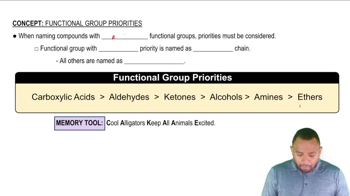
Functional Groups

Functional groups are specific groups of atoms within molecules that determine the chemical properties and reactions of those molecules. In the case of alcohols, the hydroxyl (-OH) group is the functional group that defines their behavior. Recognizing functional groups is vital for classifying compounds and predicting their reactivity in chemical reactions.
Video consigliato:
Percorso guidato
1:11
Functional Group Priorities Concept 1