Ch.14 Carboxylic Acids, Esters, Amines, and Amides
Timberlake - Chemistry: An Introduction to General, Organic, and Biological Chemistry 13th Edition
Timberlake13th EditionChemistry: An Introduction to General, Organic, and Biological ChemistryISBN: 9780134421353Non è quello che usi tu?Cambia libro di testo
Capitolo 14, Problema 13

Write the IUPAC and common names, if any, of the carboxylate salts produced in problem 14.11
a. formic acid
b. 3-chloropropanoic acid
c. benzoic acid

Guida verificata passo dopo passo
1
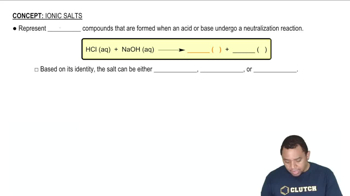
Step 1: Review problem 14.11 to identify the carboxylic acid and the base involved in the reaction that produces the carboxylate salts. Carboxylate salts are formed when a carboxylic acid reacts with a base, typically a metal hydroxide or carbonate.
Step 2: Determine the structure of the carboxylate ion by removing the hydrogen atom from the hydroxyl group (-OH) of the carboxylic acid, leaving the negatively charged carboxylate group (-COO⁻).
Step 3: Identify the cation from the base used in the reaction (e.g., Na⁺ from NaOH or K⁺ from KOH). Combine the cation with the carboxylate ion to form the carboxylate salt.
Step 4: Write the IUPAC name of the carboxylate salt by naming the cation first, followed by the name of the carboxylate ion derived from the parent carboxylic acid. For example, sodium acetate is formed from acetic acid and sodium hydroxide.
Step 5: Check if the carboxylate salt has a common name. Many carboxylate salts, such as sodium acetate or potassium benzoate, have widely recognized common names. Include both the IUPAC and common names in your answer.

Risposta video verificata per un problema simile:

Questa soluzione video è stata consigliata dai nostri tutor come utile per risolvere questo problema.
Durata del video:
5m

Concetti chiave

Ecco i concetti essenziali che devi comprendere per rispondere correttamente alla domanda.

Carboxylate Salts

Carboxylate salts are the ionic compounds formed from the deprotonation of carboxylic acids. They consist of a carboxylate anion (RCOO-) and a cation, typically a metal ion. These salts are often formed when carboxylic acids react with bases, and they play a significant role in various chemical reactions and applications, including in the food and pharmaceutical industries.
Video consigliato:

IUPAC Nomenclature

The International Union of Pure and Applied Chemistry (IUPAC) nomenclature is a systematic method for naming chemical compounds. For carboxylate salts, the IUPAC name is derived from the corresponding carboxylic acid, replacing the '-ic acid' suffix with '-ate' for the anion, followed by the name of the cation. This standardized naming convention ensures clarity and consistency in chemical communication.
Video consigliato:
Percorso guidato
3:18
IUPAC Naming Concept 3

Common Names

Common names are traditional names used for chemical compounds that may not follow IUPAC rules. They often arise from historical usage or specific applications. For carboxylate salts, common names can be more familiar and easier to remember, such as sodium acetate for sodium ethanoate. Understanding both common and IUPAC names is essential for effective communication in chemistry.