Ch.15 Lipids
Timberlake - Chemistry: An Introduction to General, Organic, and Biological Chemistry 13th Edition
Timberlake13th EditionChemistry: An Introduction to General, Organic, and Biological ChemistryISBN: 9780134421353Non è quello che usi tu?Cambia libro di testo
Capitolo 15, Problema 83

Which of the following are found in cell membranes?
a. cholesterol
b. triacylglycerols
c. carbohydrates

Guida verificata passo dopo passo
1
Understand the structure and composition of cell membranes: Cell membranes are primarily composed of a phospholipid bilayer, which includes various molecules such as lipids, proteins, and carbohydrates. These components contribute to the membrane's fluidity, structure, and function.
Analyze the role of cholesterol: Cholesterol is a type of lipid that is embedded within the phospholipid bilayer. It helps maintain membrane fluidity and stability, especially in varying temperatures. Therefore, cholesterol is found in cell membranes.
Evaluate triacylglycerols: Triacylglycerols (commonly known as triglycerides) are storage lipids and are not a structural component of cell membranes. They are primarily found in adipose tissue and serve as an energy reserve, so they are not found in cell membranes.
Consider carbohydrates: Carbohydrates are present in cell membranes, often attached to proteins (forming glycoproteins) or lipids (forming glycolipids). These carbohydrate structures play a role in cell recognition, signaling, and adhesion.
Conclude which components are found in cell membranes: Based on the analysis, cholesterol and carbohydrates are found in cell membranes, while triacylglycerols are not.

Risposta video verificata per un problema simile:

Questa soluzione video è stata consigliata dai nostri tutor come utile per risolvere questo problema.
Durata del video:
2m

Concetti chiave

Ecco i concetti essenziali che devi comprendere per rispondere correttamente alla domanda.

Cell Membrane Structure

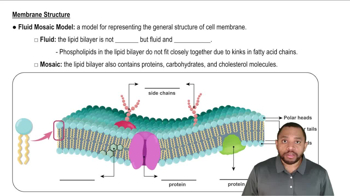
Cell membranes are primarily composed of a phospholipid bilayer, which provides a flexible barrier around the cell. This structure allows for the selective permeability of substances, enabling the cell to maintain homeostasis. Embedded within this bilayer are various proteins, cholesterol, and carbohydrates that contribute to the membrane's functionality.
Video consigliato:
Percorso guidato
1:00
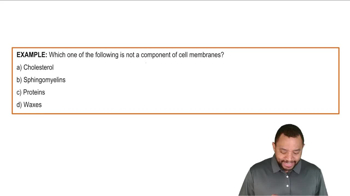
Cell Membranes Example 1

Role of Cholesterol

Cholesterol is a type of lipid that is an essential component of cell membranes. It helps to stabilize membrane fluidity, making the membrane less permeable to very small water-soluble molecules that might otherwise pass freely through. Cholesterol also plays a role in the formation of lipid rafts, which are microdomains that facilitate cell signaling.
Video consigliato:
Percorso guidato
1:35
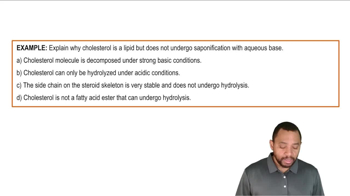
Steroids Example 1

Membrane Carbohydrates

Carbohydrates in cell membranes are typically found attached to proteins (glycoproteins) or lipids (glycolipids). These carbohydrates are crucial for cell recognition, signaling, and adhesion processes. They play a significant role in immune response and are involved in the formation of protective barriers on the cell surface.
Video consigliato:
Percorso guidato
2:34
Cell Membranes Concept 2