Ch.16 Amino Acids, Proteins, and Enzymes
Timberlake - Chemistry: An Introduction to General, Organic, and Biological Chemistry 13th Edition
Timberlake13th EditionChemistry: An Introduction to General, Organic, and Biological ChemistryISBN: 9780134421353Non è quello che usi tu?Cambia libro di testo
Capitolo 16, Problema 67

 If glutamate were replaced by proline in a protein, how might the tertiary structure be affected?

Guida verificata passo dopo passo
1
Understand the properties of glutamate and proline: Glutamate is a polar, negatively charged amino acid with a carboxylate group in its side chain, which can form ionic bonds and hydrogen bonds. Proline, on the other hand, is a nonpolar amino acid with a unique cyclic structure that restricts its flexibility and disrupts secondary structures like alpha-helices.
Consider the role of glutamate in the protein's tertiary structure: Glutamate's ability to form ionic bonds and hydrogen bonds contributes to stabilizing the protein's tertiary structure by interacting with other polar or charged residues.
Analyze the impact of replacing glutamate with proline: Proline's rigid cyclic structure introduces a kink in the polypeptide chain, which can disrupt the local secondary structure and potentially destabilize the tertiary structure. Additionally, proline lacks the ability to form the same ionic or hydrogen bonds as glutamate, which may weaken specific interactions in the protein.
Evaluate the overall effect on the protein: The replacement of glutamate with proline could lead to a loss of stability in the tertiary structure, changes in the protein's folding, or even a loss of function if the affected region is critical for the protein's activity.
Relate the changes to the protein's function: Depending on the location of the substitution, the structural changes caused by replacing glutamate with proline could alter the protein's ability to interact with other molecules, potentially impairing its biological function.

Risposta video verificata per un problema simile:

Questa soluzione video è stata consigliata dai nostri tutor come utile per risolvere questo problema.
Durata del video:
4m

Concetti chiave

Ecco i concetti essenziali che devi comprendere per rispondere correttamente alla domanda.

Amino Acid Properties

Amino acids have distinct properties that influence protein structure. Glutamate is a polar, negatively charged amino acid, while proline is a non-polar, cyclic amino acid. This difference affects how they interact with surrounding molecules and the overall stability of the protein's tertiary structure.
Video consigliato:
Percorso guidato
3:03
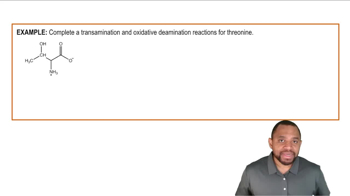
Amino Acid Catabolism: Amino Group Example 2

Tertiary Structure of Proteins

The tertiary structure of a protein refers to its three-dimensional shape, formed by the folding of the polypeptide chain. This structure is stabilized by various interactions, including hydrogen bonds, ionic bonds, and hydrophobic interactions. Changes in amino acid composition can disrupt these interactions, leading to altered protein function.
Video consigliato:
Percorso guidato
2:07
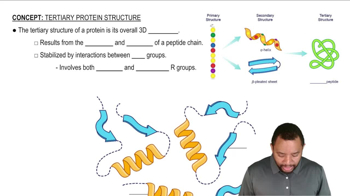
Tertiary Protein Structure Concept 1

Protein Folding and Stability

Protein folding is the process by which a polypeptide chain acquires its functional three-dimensional structure. The stability of this structure is influenced by the chemical properties of the amino acids involved. Replacing glutamate with proline could lead to misfolding or destabilization, potentially impairing the protein's biological activity.
Video consigliato:
Percorso guidato
1:17
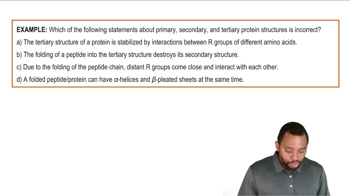
Tertiary Protein Structure Example 1