Ch.16 Amino Acids, Proteins, and Enzymes
Timberlake - Chemistry: An Introduction to General, Organic, and Biological Chemistry 13th Edition
Timberlake13th EditionChemistry: An Introduction to General, Organic, and Biological ChemistryISBN: 9780134421353Non è quello che usi tu?Cambia libro di testo
Capitolo 16, Problema 81c

Consider the amino acids lysine, valine, and aspartate in an enzyme. State which of these amino acids have R groups that would:
c. form hydrogen bonds

Guida verificata passo dopo passo
1
Identify the R groups (side chains) of the given amino acids: lysine, valine, and aspartate. Lysine has an amino group (-NH3+) in its side chain, valine has a branched alkyl group, and aspartate has a carboxyl group (-COO−) in its side chain.
Recall the conditions for hydrogen bonding: Hydrogen bonds form between a hydrogen atom covalently bonded to an electronegative atom (like O, N, or F) and another electronegative atom with a lone pair of electrons.
Analyze the R group of lysine. The amino group (-NH3+) in lysine's side chain can participate in hydrogen bonding because nitrogen is electronegative and can interact with hydrogen bond acceptors or donors.
Analyze the R group of valine. The branched alkyl group in valine is nonpolar and lacks electronegative atoms, so it cannot form hydrogen bonds.
Analyze the R group of aspartate. The carboxyl group (-COO−) in aspartate's side chain contains oxygen atoms, which are electronegative and can act as hydrogen bond acceptors, allowing aspartate to form hydrogen bonds.

Risposta video verificata per un problema simile:

Questa soluzione video è stata consigliata dai nostri tutor come utile per risolvere questo problema.
Durata del video:
6m

Concetti chiave

Ecco i concetti essenziali che devi comprendere per rispondere correttamente alla domanda.

Amino Acid Structure

Amino acids are organic compounds that serve as the building blocks of proteins. Each amino acid consists of a central carbon atom, an amino group, a carboxyl group, a hydrogen atom, and a variable R group (side chain). The R group determines the unique properties of each amino acid, influencing how they interact with each other and with other molecules.
Video consigliato:
Percorso guidato
3:03
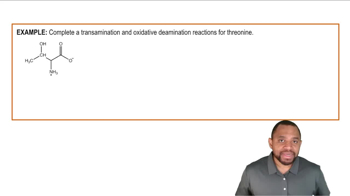
Amino Acid Catabolism: Amino Group Example 2

Hydrogen Bonding

Hydrogen bonds are weak attractions that occur between a hydrogen atom covalently bonded to an electronegative atom and another electronegative atom. In the context of amino acids, R groups that contain polar functional groups, such as hydroxyl (-OH) or amine (-NH2) groups, can participate in hydrogen bonding, which is crucial for protein structure and function.
Video consigliato:
Percorso guidato
1:22
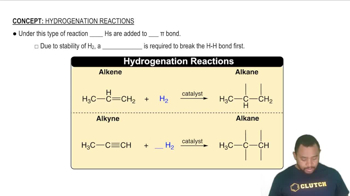
Hydrogenation Reactions Concept 1

Polarity of R Groups

The polarity of an amino acid's R group affects its ability to form hydrogen bonds. Polar R groups, which have uneven distribution of electrical charge, can interact with water and other polar molecules, facilitating hydrogen bond formation. In contrast, nonpolar R groups do not engage in hydrogen bonding, impacting the overall behavior of proteins in biological systems.
Video consigliato:
Percorso guidato
01:34
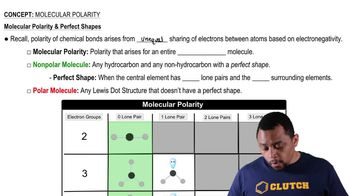
Molecular Polarity (Simplified) Concept 1