Ch.17 Nucleic Acids and Protein Synthesis
Timberlake - Chemistry: An Introduction to General, Organic, and Biological Chemistry 13th Edition
Timberlake13th EditionChemistry: An Introduction to General, Organic, and Biological ChemistryISBN: 9780134421353Non è quello che usi tu?Cambia libro di testo
Capitolo 17, Problema 89c

Answer the following questions for the given section of DNA:
c. Write the three-letter symbols for the amino acids that would go into the peptide from the mRNA you wrote in part b.

Guida verificata passo dopo passo
1
Identify the DNA sequence provided in the problem and determine the complementary mRNA sequence by replacing thymine (T) with uracil (U) and pairing adenine (A) with uracil (U), cytosine (C) with guanine (G), guanine (G) with cytosine (C), and thymine (T) with adenine (A).
Divide the mRNA sequence into codons, which are groups of three nucleotides. Each codon corresponds to a specific amino acid.
Use the genetic code chart to translate each mRNA codon into its corresponding amino acid. For example, the codon AUG codes for methionine (Met), and UUU codes for phenylalanine (Phe).
Write the three-letter symbols for the amino acids in the order they appear based on the mRNA sequence. Ensure the sequence is accurate and matches the codons derived from the mRNA.
Verify the peptide sequence by cross-checking the codons and their corresponding amino acids using the genetic code chart to ensure no errors in translation.

Risposta video verificata per un problema simile:

Questa soluzione video è stata consigliata dai nostri tutor come utile per risolvere questo problema.
Durata del video:
2m

Concetti chiave

Ecco i concetti essenziali che devi comprendere per rispondere correttamente alla domanda.

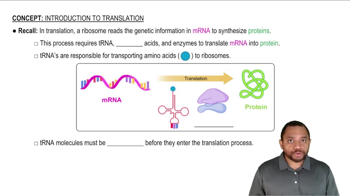
mRNA Translation

mRNA translation is the process by which ribosomes synthesize proteins using the information encoded in messenger RNA (mRNA). The mRNA sequence is read in sets of three nucleotides, known as codons, each of which corresponds to a specific amino acid. Understanding this process is crucial for determining the amino acid sequence of a peptide based on the mRNA provided.
Video consigliato:
Percorso guidato
1:42
Introduction to Translation Concept 1

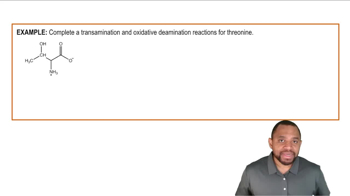
Amino Acid Codons

Amino acids are the building blocks of proteins, and each amino acid is represented by a specific three-letter codon in the genetic code. There are 20 standard amino acids, and the codons are derived from the nucleotide sequence of mRNA. Familiarity with the codon table is essential for translating mRNA sequences into their corresponding amino acids accurately.
Video consigliato:
Percorso guidato
3:03
Amino Acid Catabolism: Amino Group Example 2

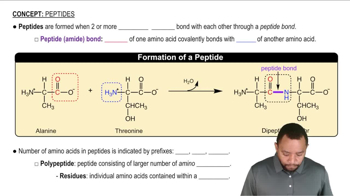
Peptide Formation

Peptide formation occurs when amino acids are linked together by peptide bonds during translation, resulting in a polypeptide chain that eventually folds into a functional protein. The sequence of amino acids in a peptide is determined by the mRNA sequence, making it important to correctly interpret the mRNA to predict the resulting peptide structure and function.
Video consigliato:
Percorso guidato
3:07
Peptides Concept 1