Ch.17 Nucleic Acids and Protein Synthesis
Timberlake - Chemistry: An Introduction to General, Organic, and Biological Chemistry 13th Edition
Timberlake13th EditionChemistry: An Introduction to General, Organic, and Biological ChemistryISBN: 9780134421353Non è quello che usi tu?Cambia libro di testo
Capitolo 17, Problema 96

How do the bases cytosine and uracil differ?

Guida verificata passo dopo passo
1
Understand that cytosine and uracil are nitrogenous bases found in nucleic acids. Cytosine is present in both DNA and RNA, while uracil is found only in RNA.
Recognize that cytosine is a pyrimidine base with the chemical formula C₄H₅N₃O, while uracil is also a pyrimidine base but has the chemical formula C₄H₄N₂O₂.
Note the structural difference: Cytosine contains an amine group (-NH₂) attached to its ring structure, whereas uracil lacks this amine group and instead has a ketone group (=O) at the same position.
Understand the functional implications: Cytosine can form three hydrogen bonds with guanine in DNA and RNA, while uracil pairs with adenine in RNA through two hydrogen bonds.
Summarize the key difference: Cytosine has an amine group, making it more chemically reactive, while uracil has a simpler structure with a ketone group, reflecting its role in RNA instead of DNA.

Risposta video verificata per un problema simile:

Questa soluzione video è stata consigliata dai nostri tutor come utile per risolvere questo problema.
Durata del video:
2m

Concetti chiave

Ecco i concetti essenziali che devi comprendere per rispondere correttamente alla domanda.

Nucleotide Structure

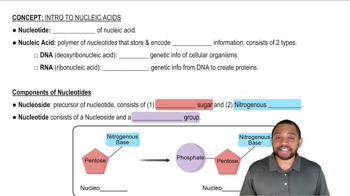
Nucleotides are the building blocks of nucleic acids, consisting of a sugar, a phosphate group, and a nitrogenous base. Cytosine and uracil are both nitrogenous bases, but they differ in their chemical structure. Cytosine is a pyrimidine base with an amine group, while uracil lacks this amine group, which influences their roles in RNA and DNA.
Video consigliato:
Percorso guidato
1:19
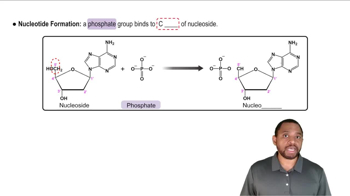
Nucleoside and Nucleotide Formation Concept 2

Base Pairing

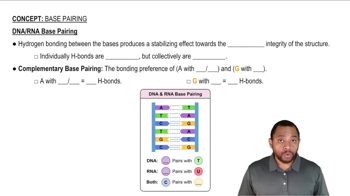
Base pairing is a fundamental concept in molecular biology that describes how nitrogenous bases pair with each other in nucleic acids. In DNA, cytosine pairs with guanine, while uracil, which is found in RNA, pairs with adenine. Understanding these pairing rules is essential for grasping how genetic information is stored and transmitted.
Video consigliato:
Percorso guidato
2:56
Base Pairing Concept 1

Function in Nucleic Acids

Cytosine and uracil play distinct roles in nucleic acids. Cytosine is found in both DNA and RNA, contributing to the stability and structure of DNA, while uracil is primarily found in RNA, where it participates in protein synthesis. The presence of uracil instead of thymine in RNA is a key difference that affects the overall function and stability of the genetic material.
Video consigliato:
Percorso guidato
1:55
Intro to Nucleic Acids Concept 1