Ch.17 Nucleic Acids and Protein Synthesis
Timberlake - Chemistry: An Introduction to General, Organic, and Biological Chemistry 13th Edition
Timberlake13th EditionChemistry: An Introduction to General, Organic, and Biological ChemistryISBN: 9780134421353Non è quello che usi tu?Cambia libro di testo
Capitolo 17, Problema 46

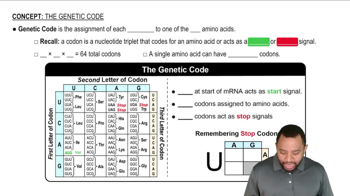
The codons UGA, UAA, and UAG do not code for amino acids. What is their role as codons in mRNA?

Guida verificata passo dopo passo
1
Understand that codons are sequences of three nucleotides in mRNA that correspond to specific amino acids or signals during protein synthesis.
Recognize that UGA, UAA, and UAG are special codons known as 'stop codons' in the genetic code.
Explain that stop codons do not code for any amino acids. Instead, they signal the termination of translation, the process by which ribosomes synthesize proteins.
When a ribosome encounters a stop codon in the mRNA sequence, it releases the newly synthesized polypeptide chain, effectively ending protein synthesis.
Conclude that the role of UGA, UAA, and UAG is to act as termination signals, ensuring that proteins are synthesized to the correct length as dictated by the mRNA sequence.

Risposta video verificata per un problema simile:

Questa soluzione video è stata consigliata dai nostri tutor come utile per risolvere questo problema.
Durata del video:
1m

Concetti chiave

Ecco i concetti essenziali che devi comprendere per rispondere correttamente alla domanda.

Stop Codons

Stop codons are specific sequences in mRNA that signal the termination of protein synthesis. The codons UGA, UAA, and UAG are classified as stop codons because they do not correspond to any amino acids. Instead, they instruct the ribosome to halt translation, ensuring that the protein is completed correctly.
Video consigliato:
Percorso guidato
03:25
The Genetic Code Concept 1

Translation Process

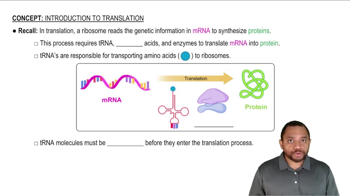
Translation is the process by which ribosomes synthesize proteins using mRNA as a template. During translation, ribosomes read the sequence of codons in mRNA and assemble the corresponding amino acids into a polypeptide chain. Stop codons play a crucial role in this process by indicating when the ribosome should stop adding amino acids.
Video consigliato:
Percorso guidato
1:42
Introduction to Translation Concept 1

Genetic Code

The genetic code is a set of rules that defines how sequences of nucleotides in mRNA are translated into amino acids. It consists of 64 codons, including 61 that code for amino acids and 3 that serve as stop signals. Understanding the genetic code is essential for interpreting how genes are expressed and how proteins are synthesized.
Video consigliato:
Percorso guidato
03:25
The Genetic Code Concept 1