Ch.17 Nucleic Acids and Protein Synthesis
Timberlake - Chemistry: An Introduction to General, Organic, and Biological Chemistry 13th Edition
Timberlake13th EditionChemistry: An Introduction to General, Organic, and Biological ChemistryISBN: 9780134421353Non è quello che usi tu?Cambia libro di testo
Capitolo 17, Problema 31

What process ensures that the replication of DNA produces identical copies?

Guida verificata passo dopo passo
1
Understand that DNA replication is the process by which a cell copies its DNA before cell division, ensuring that each daughter cell receives an identical copy of the genetic material.
Recognize that the process relies on the principle of complementary base pairing, where adenine (A) pairs with thymine (T) and cytosine (C) pairs with guanine (G). This ensures accuracy in the replication process.
Learn that the enzyme DNA helicase unwinds the double helix, separating the two strands to serve as templates for the new strands.
Understand that DNA polymerase is the key enzyme that adds complementary nucleotides to the exposed bases on each template strand, synthesizing the new strands in a 5' to 3' direction.
Note that proofreading mechanisms within DNA polymerase help correct errors during replication, ensuring high fidelity and the production of identical DNA copies.

Risposta video verificata per un problema simile:

Questa soluzione video è stata consigliata dai nostri tutor come utile per risolvere questo problema.
Durata del video:
4m

Concetti chiave

Ecco i concetti essenziali che devi comprendere per rispondere correttamente alla domanda.

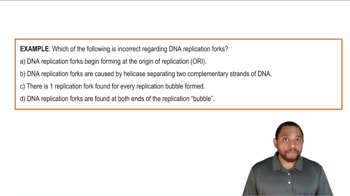
DNA Replication

DNA replication is the biological process by which a cell duplicates its DNA, ensuring that each new cell receives an identical copy of the genetic material. This process involves unwinding the double helix structure of DNA and synthesizing new complementary strands using existing strands as templates.
Video consigliato:
Percorso guidato
1:40
Intro to DNA Replication Example 2

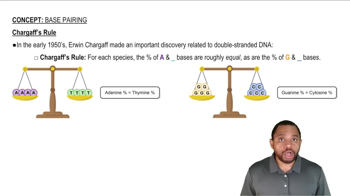
Base Pairing Rules

Base pairing rules are fundamental to DNA replication, dictating how nucleotides pair with each other: adenine pairs with thymine, and cytosine pairs with guanine. This specificity ensures that the new strands formed during replication are exact complements of the original strands, maintaining genetic fidelity.
Video consigliato:
Percorso guidato
2:01
Base Pairing Concept 2

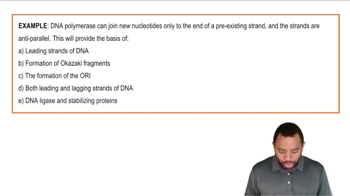
DNA Polymerase

DNA polymerase is an essential enzyme that plays a critical role in DNA replication. It synthesizes new DNA strands by adding nucleotides to a growing chain, following the base pairing rules, and also has proofreading capabilities to correct any errors, further ensuring the accuracy of the replicated DNA.
Video consigliato:
Percorso guidato
1:31
Steps of DNA Replication Example 1