Ch.2 Chemistry and Measurements
Timberlake - Chemistry: An Introduction to General, Organic, and Biological Chemistry 13th Edition
Timberlake13th EditionChemistry: An Introduction to General, Organic, and Biological ChemistryISBN: 9780134421353Non è quello che usi tu?Cambia libro di testo
Capitolo 2, Problema 91

Consider the following solids. The solids A, B, and C represent aluminum (D = 2.70g/mL), and silver (D = 10.5 g/mL). If each has a mass of 10.0 g, what is the identity of each solid?
<IMAGE>

Guida verificata passo dopo passo
1
Step 1: Recall the formula for density, which is \( D = \frac{m}{V} \), where \( D \) is density, \( m \) is mass, and \( V \) is volume. Rearrange the formula to solve for volume: \( V = \frac{m}{D} \).
Step 2: Identify the given values for each solid. The mass of each solid is \( 10.0 \, \text{g} \), and the densities of aluminum and silver are \( 2.70 \; \text{g/mL} \) and \( 10.5 \; \text{g/mL} \), respectively.
Step 3: Calculate the volume of each solid using the formula \( V = \frac{m}{D} \). For aluminum, substitute \( m = 10.0 \, \text{g} \) and \( D = 2.70 \; \text{g/mL} \). For silver, substitute \( m = 10.0 \, \text{g} \) and \( D = 10.5 \; \text{g/mL} \).
Step 4: Compare the calculated volumes to the visual representation of the solids in the image. The solid with the largest volume corresponds to aluminum (lower density), and the solid with the smallest volume corresponds to silver (higher density).
Step 5: Match the calculated volumes to the sizes of solids A, B, and C in the image to identify their identities. The largest solid is aluminum, and the smallest solid is silver.

Risposta video verificata per un problema simile:

Questa soluzione video è stata consigliata dai nostri tutor come utile per risolvere questo problema.
Durata del video:
2m

Concetti chiave

Ecco i concetti essenziali che devi comprendere per rispondere correttamente alla domanda.

Density

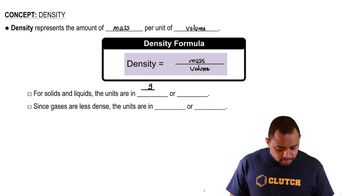
Density is defined as mass per unit volume, typically expressed in grams per milliliter (g/mL) for solids and liquids. It is a crucial property that helps identify materials, as different substances have unique densities. In this question, the densities of aluminum (2.70 g/mL) and silver (10.5 g/mL) are provided, allowing for the identification of the solids based on their mass and volume.
Video consigliato:

Mass and Volume Relationship

The relationship between mass and volume is fundamental in determining density. For a given mass, the volume can be calculated using the formula: Volume = Mass / Density. In this scenario, since each solid has a mass of 10.0 g, the volume can be derived from the known densities, which will help in identifying each solid based on their respective volumes.
Video consigliato:
Percorso guidato
04:56
Logarithmic Relationships

Material Identification

Material identification involves using physical properties, such as density, to distinguish between different substances. By calculating the volume of each solid using their mass and known densities, one can match the calculated volumes to the expected volumes for aluminum and silver. This process is essential in determining which solid corresponds to which material in the given problem.
Video consigliato:
Percorso guidato
07:46
Laboratory Materials 2