A graduated cylinder contains 155 mL of water. A 15.0-g piece of iron and a 20.0-g piece of lead are added. What is the new water level, in milliliters, in the cylinder?
Ch.2 Chemistry and Measurements
Timberlake13th EditionChemistry: An Introduction to General, Organic, and Biological ChemistryISBN: 9780134421353Non è quello che usi tu?Cambia libro di testo
Capitolo 2, Problema 105
The water level in a graduated cylinder initially at 215 mL rises to 285 mL after a piece of lead is submerged. What is the mass, in grams, of the lead?
Guida verificata passo dopo passo1
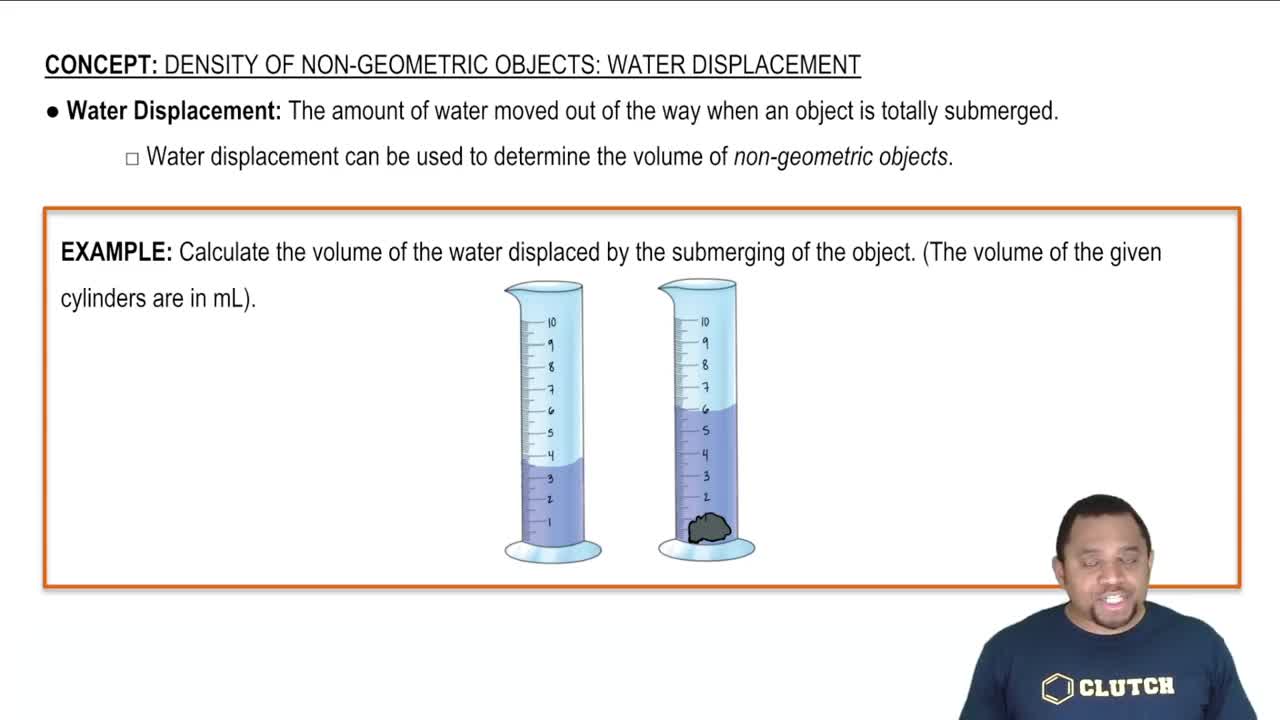
Determine the volume of the lead by calculating the difference in water levels before and after the lead is submerged. Use the formula: , where V f is the final volume (285 mL) and V i is the initial volume (215 mL).
Look up the density of lead in Table 2.8. Density () is typically given in units of g/mL for solids like lead.
Use the formula for mass based on density and volume: , where is the mass, is the density, and is the volume of the lead calculated in Step 1.
Substitute the values for the density of lead and the volume of the lead into the formula from Step 3.
Perform the multiplication to find the mass of the lead in grams. Ensure the units are consistent (e.g., mL for volume and g/mL for density) to get the correct result.

Risposta video verificata per un problema simile:
Questa soluzione video è stata consigliata dai nostri tutor come utile per risolvere questo problema.
Durata del video:
3mConcetti chiave
Ecco i concetti essenziali che devi comprendere per rispondere correttamente alla domanda.
Volume Displacement
Volume displacement refers to the principle that when an object is submerged in a fluid, it displaces a volume of fluid equal to the volume of the object. In this case, the rise in water level from 215 mL to 285 mL indicates that the lead piece displaced 70 mL of water, which is crucial for calculating its mass.
Video consigliato:
Percorso guidato
Density of Non-Geometric Objects Concept and Example
Density
Density is defined as mass per unit volume and is a key property of materials. It can be calculated using the formula density = mass/volume. For the lead piece, knowing its density allows us to determine its mass using the volume of water displaced, as lead has a specific density value that can be referenced in a table.
Video consigliato:
Percorso guidato
Density
Mass Calculation
Mass calculation involves using the relationship between mass, volume, and density to find the mass of an object. In this scenario, once the volume of the lead is determined through displacement, the mass can be calculated by multiplying the volume of the displaced water (70 mL) by the density of lead, which is typically around 11.34 g/cm³.
Video consigliato:
Percorso guidato
Calculating Molar Mass
Pratica correlata
Domanda del libro di testo
2174
views
Domanda del libro di testo
In France, grapes are 1.95 euros per kilogram. What is the cost of grapes, in dollars per pound, if the exchange rate is 1.14 dollars/euro?
2203
views
Domanda del libro di testo
How many milliliters of gasoline have a mass of 1.2 kg?
2127
views
Domanda del libro di testo
To treat a bacterial infection, a doctor orders 4 tablets of amoxicillin per day for 10 days. If each tablet contains 250 mg of amoxicillin, how many ounces of the medication are given in 10 days?
2246
views
Domanda del libro di testo
The gray cube has a density of 4.5 g/cm3. Is the density of the green cube the same, lower than, or higher than that of the gray cube?
<IMAGE>
2787
views
Domanda del libro di testo
In Mexico, avocados are 48 pesos per kilogram. What is the cost, in cents, of an avocado that weighs 0.45 lb if the exchange rate is 18 pesos to the dollar?
2036
views