Ch.2 Chemistry and Measurements
Timberlake - Chemistry: An Introduction to General, Organic, and Biological Chemistry 13th Edition
Timberlake13th EditionChemistry: An Introduction to General, Organic, and Biological ChemistryISBN: 9780134421353Non è quello che usi tu?Cambia libro di testo
Capitolo 2, Problema 64a

Using conversion factors, solve each of the following clinical problems:
a. The physician has ordered 1.0 g of tetracycline to be given every six hours to a patient. If your stock on hand is 500-mg tablets, how many will you need for one day's treatment?

Guida verificata passo dopo passo
1
Step 1: Identify the total amount of tetracycline needed for one day's treatment. Since the physician has ordered 1.0 g every six hours, calculate the total number of doses in a day. There are 24 hours in a day, so divide 24 hours by 6 hours per dose to determine the number of doses per day.
Step 2: Multiply the number of doses per day by the amount of tetracycline required per dose (1.0 g). This will give the total amount of tetracycline needed for one day.
Step 3: Convert the total amount of tetracycline needed from grams to milligrams. Use the conversion factor: \( 1 \, \text{g} = 1000 \, \text{mg} \). Multiply the total grams by 1000 to find the equivalent in milligrams.
Step 4: Determine how many 500-mg tablets are needed to provide the total milligrams of tetracycline required for one day. Divide the total milligrams of tetracycline by 500 mg per tablet.
Step 5: Ensure the result is a whole number, as you cannot administer a fraction of a tablet. If necessary, round up to the nearest whole number to ensure the patient receives the correct dosage.

Risposta video verificata per un problema simile:

Questa soluzione video è stata consigliata dai nostri tutor come utile per risolvere questo problema.
Durata del video:
1m

Concetti chiave

Ecco i concetti essenziali che devi comprendere per rispondere correttamente alla domanda.

Conversion Factors

Conversion factors are ratios used to convert one unit of measurement to another. In clinical settings, they are essential for ensuring accurate dosages of medications. For example, knowing that 1 gram equals 1000 milligrams allows healthcare professionals to convert the prescribed dosage into the available form.
Video consigliato:
Percorso guidato
03:45
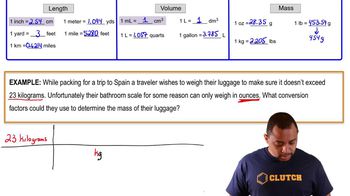
Conversion Factors (Simplified) Example 2

Dosage Calculation

Dosage calculation involves determining the correct amount of medication to administer based on the physician's orders and the available stock. This process often requires understanding the frequency of administration and the total daily dosage, which is crucial for patient safety and effective treatment.
Video consigliato:
Percorso guidato
03:13
Calculate Oxidation Numbers

Medication Administration Schedule

The medication administration schedule outlines how often a medication should be given to a patient. In this case, the physician has prescribed tetracycline every six hours, which means the total daily dosage must be calculated based on this frequency to ensure the patient receives the correct amount over a 24-hour period.
Video consigliato:
Percorso guidato
00:58
Significant Figures (Simplified) Example 1