Ch.3 Matter and Energy
Timberlake - Chemistry: An Introduction to General, Organic, and Biological Chemistry 13th Edition
Timberlake13th EditionChemistry: An Introduction to General, Organic, and Biological ChemistryISBN: 9780134421353Non è quello che usi tu?Cambia libro di testo
Capitolo 3, Problema 5b

A dietitian includes one of the following mixtures in the lunch menu. Classify each as homogeneous or heterogeneous.
b. tea

Guida verificata passo dopo passo
1
Understand the definitions of homogeneous and heterogeneous mixtures: A homogeneous mixture has a uniform composition throughout, meaning the components are evenly distributed and not visibly distinguishable. A heterogeneous mixture has a non-uniform composition, where the components are visibly distinct or unevenly distributed.
Consider the composition of tea: Tea is typically made by dissolving tea compounds in water, resulting in a uniform liquid where the dissolved substances are evenly distributed.
Determine if the components of tea are visibly distinguishable: In a properly prepared tea, the dissolved compounds and water form a single phase, and the components are not visibly distinct.
Classify the mixture: Since tea has a uniform composition and the components are not visibly distinguishable, it is classified as a homogeneous mixture.
Note exceptions: If the tea contains undissolved particles, such as tea leaves or other solid additives, it would then be classified as a heterogeneous mixture. However, this is not the case for a typical prepared tea.

Risposta video verificata per un problema simile:

Questa soluzione video è stata consigliata dai nostri tutor come utile per risolvere questo problema.
Durata del video:
42s

Concetti chiave

Ecco i concetti essenziali che devi comprendere per rispondere correttamente alla domanda.

Homogeneous Mixtures

Homogeneous mixtures are uniform in composition and appearance, meaning that the individual components are not distinguishable. An example is a solution where the solute is completely dissolved in the solvent, resulting in a consistent mixture throughout. In the context of the question, a homogeneous mixture would appear the same throughout, regardless of where you sample it.
Video consigliato:
Percorso guidato
02:35
Solubility and Intermolecular Forces Concept 1

Heterogeneous Mixtures

Heterogeneous mixtures consist of visibly different substances or phases. The components can often be separated by physical means, and their distribution is not uniform. For instance, a salad is a heterogeneous mixture because you can see and identify the individual ingredients, which do not blend into a single phase.
Video consigliato:
Percorso guidato
02:35
Solubility and Intermolecular Forces Concept 1

Classification of Mixtures

The classification of mixtures into homogeneous and heterogeneous is essential in chemistry and food science. This classification helps in understanding the properties and behaviors of different mixtures. In the case of tea, whether it is classified as homogeneous or heterogeneous depends on whether the tea leaves are present or if the mixture is fully brewed and clear.
Video consigliato:
Percorso guidato
04:19
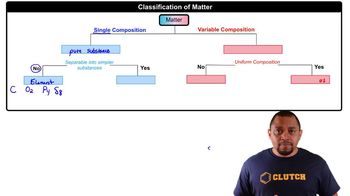
Classification of Matter