Ch.3 Matter and Energy
Timberlake - Chemistry: An Introduction to General, Organic, and Biological Chemistry 13th Edition
Timberlake13th EditionChemistry: An Introduction to General, Organic, and Biological ChemistryISBN: 9780134421353Non è quello che usi tu?Cambia libro di testo
Capitolo 3, Problema 21

Discuss the changes in the potential and kinetic energy of a roller-coaster ride as the roller-coaster car climbs to the top and goes down the other side.

Guida verificata passo dopo passo
1
As the roller-coaster car climbs to the top, its potential energy increases because potential energy is directly proportional to height. The formula for potential energy is Ep=mgh, where m is the mass of the car, g is the acceleration due to gravity, and h is the height.
During the climb, the kinetic energy of the roller-coaster car decreases because the car slows down as it works against gravity. Kinetic energy is given by the formula Ek=12mv2, where v is the velocity of the car.
At the top of the climb, the roller-coaster car has maximum potential energy and minimum kinetic energy because its height is at its peak and its velocity is at its lowest.
As the roller-coaster car descends the other side, its potential energy decreases because the height decreases. The energy is converted into kinetic energy as the car accelerates downward.
At the bottom of the descent, the roller-coaster car has maximum kinetic energy and minimum potential energy because its velocity is at its peak and its height is at its lowest.

Risposta video verificata per un problema simile:

Questa soluzione video è stata consigliata dai nostri tutor come utile per risolvere questo problema.
Durata del video:
4m

Concetti chiave

Ecco i concetti essenziali che devi comprendere per rispondere correttamente alla domanda.

Potential Energy

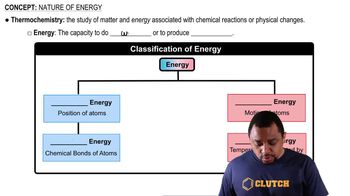
Potential energy is the energy stored in an object due to its position or height. In the context of a roller coaster, as the car climbs to the top of a hill, its height increases, resulting in a rise in potential energy. This energy is dependent on the mass of the car and the height it reaches, calculated using the formula PE = mgh, where m is mass, g is the acceleration due to gravity, and h is height.
Video consigliato:
Percorso guidato
01:26
Nature of Energy

Kinetic Energy

Kinetic energy is the energy of motion, which increases as an object's speed increases. For a roller coaster, as the car descends from the top of a hill, its potential energy converts into kinetic energy, causing the car to accelerate. The kinetic energy can be calculated using the formula KE = 1/2 mv², where m is mass and v is velocity, illustrating how speed impacts the energy of the moving car.
Video consigliato:
Percorso guidato
01:19
Kinetic Molecular Theory Concept 1

Conservation of Energy

The principle of conservation of energy states that energy cannot be created or destroyed, only transformed from one form to another. In a roller coaster ride, the total mechanical energy (the sum of potential and kinetic energy) remains constant, assuming negligible friction. As the car climbs, potential energy increases while kinetic energy decreases, and as it descends, the reverse occurs, demonstrating this fundamental principle of physics.
Video consigliato:
Percorso guidato
01:48
Law of Conservation of Mass