Ch.4 Atoms and Elements
Timberlake - Chemistry: An Introduction to General, Organic, and Biological Chemistry 13th Edition
Timberlake13th EditionChemistry: An Introduction to General, Organic, and Biological ChemistryISBN: 9780134421353Non è quello che usi tu?Cambia libro di testo
Capitolo 4, Problema 116a

Give the symbol of the element that has the
a. largest atomic size in Group 1A (1)

Guida verificata passo dopo passo
1
Step 1: Understand the periodic trend for atomic size. Atomic size increases as you move down a group in the periodic table because additional electron shells are added, which increases the distance between the nucleus and the outermost electrons.
Step 2: Identify the elements in Group 1A (1). These are the alkali metals: hydrogen (H), lithium (Li), sodium (Na), potassium (K), rubidium (Rb), cesium (Cs), and francium (Fr).
Step 3: Determine which element is at the bottom of Group 1A (1). The element at the bottom of the group will have the largest atomic size due to the maximum number of electron shells.
Step 4: Recall that francium (Fr) is the last element in Group 1A (1) and is located at the bottom of the group in the periodic table.
Step 5: Conclude that the element with the largest atomic size in Group 1A (1) is francium (Fr).

Risposta video verificata per un problema simile:

Questa soluzione video è stata consigliata dai nostri tutor come utile per risolvere questo problema.
Durata del video:
3m

Concetti chiave

Ecco i concetti essenziali che devi comprendere per rispondere correttamente alla domanda.

Atomic Size

Atomic size refers to the distance from the nucleus of an atom to the outermost shell of electrons. It is influenced by the number of electron shells and the effective nuclear charge. In general, atomic size increases down a group in the periodic table due to the addition of electron shells.
Video consigliato:

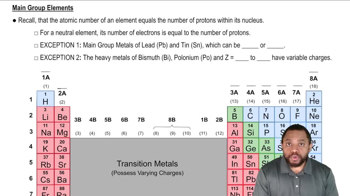
Group 1A Elements

Group 1A, also known as the alkali metals, includes elements like lithium (Li), sodium (Na), potassium (K), rubidium (Rb), cesium (Cs), and francium (Fr). These elements have one electron in their outermost shell, which they readily lose to form positive ions, making them highly reactive and contributing to their atomic size characteristics.
Video consigliato:
Percorso guidato
07:38
Periodic Table: Main Group Element Charges Concept 2

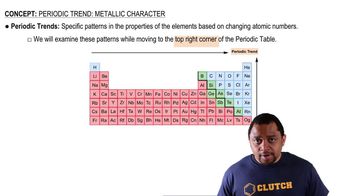
Periodic Trends

Periodic trends are patterns observed in the periodic table that describe how certain properties of elements change across periods and down groups. For atomic size, the trend shows that atomic radii increase down a group due to the addition of electron shells, while they generally decrease across a period due to increased nuclear charge pulling electrons closer to the nucleus.
Video consigliato:
Percorso guidato
00:38
Periodic Trend: Metallic Character