Ch.4 Atoms and Elements
Timberlake - Chemistry: An Introduction to General, Organic, and Biological Chemistry 13th Edition
Timberlake13th EditionChemistry: An Introduction to General, Organic, and Biological ChemistryISBN: 9780134421353Non è quello che usi tu?Cambia libro di testo
Capitolo 4, Problema 7b

Identify the group or period number described by each of the following:
b. begins with helium

Guida verificata passo dopo passo
1
Step 1: Recall that the periodic table is organized into groups (vertical columns) and periods (horizontal rows). Groups are numbered from 1 to 18, and periods are numbered from 1 to 7.
Step 2: Identify the element helium (He) on the periodic table. Helium is located in the top right corner of the table.
Step 3: Determine the period number for helium. Periods are horizontal rows, and helium is in the first row, so it belongs to Period 1.
Step 4: Determine the group number for helium. Helium is part of the noble gases, which are located in Group 18 (the last column of the periodic table).
Step 5: Conclude that helium begins Period 1 and is part of Group 18. This information can be used to answer the question about its group or period number.

Risposta video verificata per un problema simile:

Questa soluzione video è stata consigliata dai nostri tutor come utile per risolvere questo problema.
Durata del video:
1m

Concetti chiave

Ecco i concetti essenziali che devi comprendere per rispondere correttamente alla domanda.

Noble Gases

Noble gases are a group of chemical elements in Group 18 of the periodic table, known for their lack of reactivity due to having a full valence shell of electrons. This group includes helium, neon, argon, krypton, xenon, and radon. Helium, the lightest noble gas, is often used in balloons and as a cooling medium in cryogenics.
Video consigliato:
Percorso guidato
14:42
Test for Anions

Periodic Table Groups

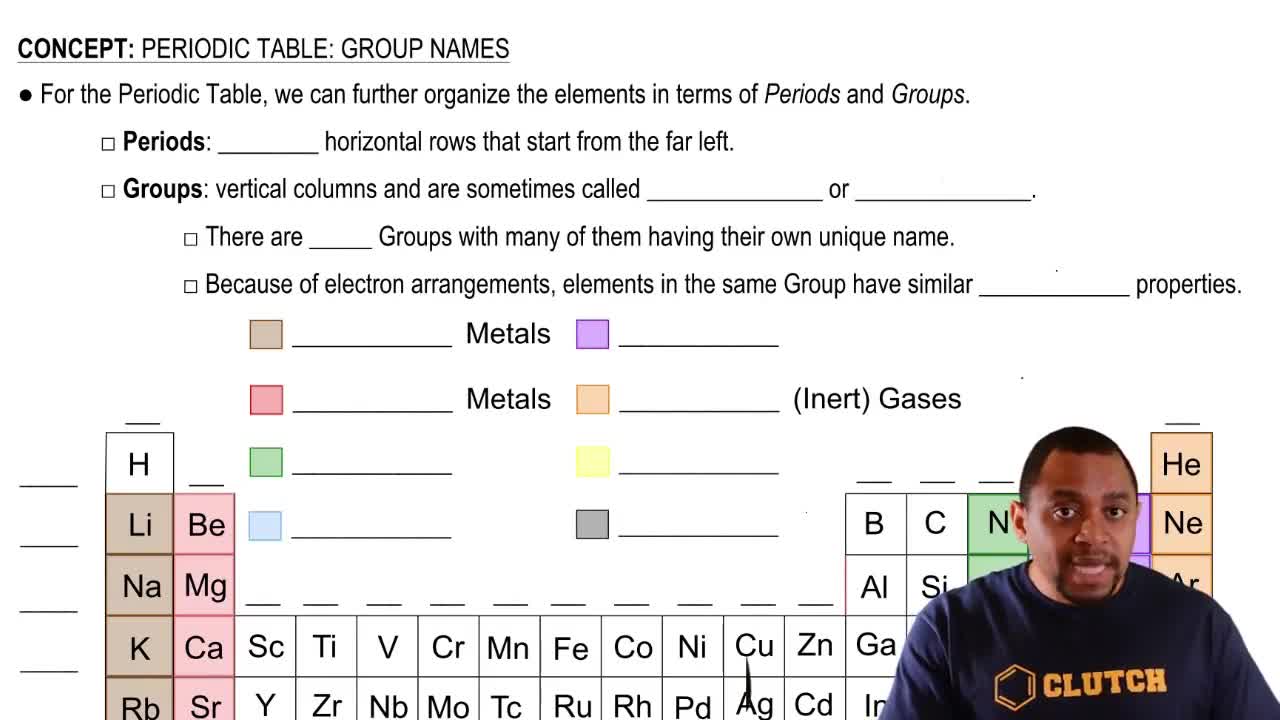
The periodic table is organized into columns called groups, which contain elements with similar chemical properties. Each group is numbered from 1 to 18, with Group 1 containing alkali metals and Group 18 containing noble gases. Understanding the group number helps predict the behavior and reactivity of elements.
Video consigliato:
Percorso guidato
05:33
Periodic Table: Group Names

Element Positioning

The position of an element in the periodic table is determined by its atomic number, which corresponds to the number of protons in its nucleus. Elements are arranged in order of increasing atomic number, and their placement in specific groups and periods reflects their electronic configuration and chemical properties. Helium, for instance, is positioned at the top of Group 18.
Video consigliato:
Percorso guidato
01:14
Valence Electrons of Elements (Simplified) Example 1