Ch.5 Nuclear Chemistry
Timberlake - Chemistry: An Introduction to General, Organic, and Biological Chemistry 13th Edition
Timberlake13th EditionChemistry: An Introduction to General, Organic, and Biological ChemistryISBN: 9780134421353Non è quello che usi tu?Cambia libro di testo
Capitolo 5, Problema 86

The half-life for the radioactive decay of Ce-141 is 32.5 days. If a sample has an activity of 4.0 µCi after 130 days have elapsed, what was the initial activity, in microcuries, of the sample?

Guida verificata passo dopo passo
1
Understand the problem: The half-life of Ce-141 is 32.5 days, and the activity of the sample after 130 days is 4.0 µCi. We need to calculate the initial activity of the sample using the radioactive decay formula.
Use the radioactive decay formula: \( A = A_0 \cdot e^{-kt} \), where \( A \) is the activity at time \( t \), \( A_0 \) is the initial activity, \( k \) is the decay constant, and \( t \) is the elapsed time.
Calculate the decay constant \( k \) using the relationship between half-life and \( k \): \( k = \frac{\ln(2)}{t_{1/2}} \). Substitute \( t_{1/2} = 32.5 \; \text{days} \) into the equation to find \( k \).
Rearrange the decay formula to solve for \( A_0 \): \( A_0 = \frac{A}{e^{-kt}} \). Substitute \( A = 4.0 \; \mu\text{Ci} \), \( k \) (calculated in the previous step), and \( t = 130 \; \text{days} \) into the equation.
Simplify the expression to calculate \( A_0 \), which represents the initial activity of the sample in microcuries.

Risposta video verificata per un problema simile:

Questa soluzione video è stata consigliata dai nostri tutor come utile per risolvere questo problema.
Durata del video:
4m

Concetti chiave

Ecco i concetti essenziali che devi comprendere per rispondere correttamente alla domanda.

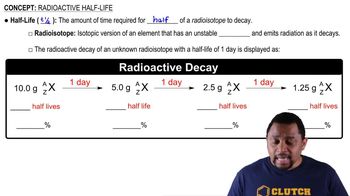
Half-Life

Half-life is the time required for half of the radioactive nuclei in a sample to decay. It is a crucial concept in understanding radioactive decay processes, as it allows us to predict how long it will take for a given amount of a radioactive substance to reduce to a specific fraction of its original quantity. In this case, the half-life of Ce-141 is 32.5 days.
Video consigliato:
Percorso guidato
02:09
Radioactive Half-Life Concept 1

Radioactive Decay

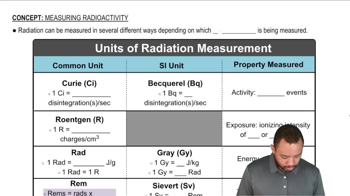
Radioactive decay is the process by which an unstable atomic nucleus loses energy by emitting radiation. This process results in the transformation of the original element into a different element or isotope. The activity of a radioactive sample, measured in microcuries (µCi), indicates the rate of decay and is directly related to the number of radioactive atoms present in the sample.
Video consigliato:
Percorso guidato
02:52
Measuring Radioactivity Concept 1

Exponential Decay Formula

The exponential decay formula describes how the quantity of a radioactive substance decreases over time. It is expressed as N(t) = N0 * (1/2)^(t/T), where N(t) is the remaining quantity at time t, N0 is the initial quantity, and T is the half-life. This formula is essential for calculating the initial activity of the sample based on the activity observed after a certain period, allowing for the determination of how much of the substance has decayed.
Video consigliato:
Percorso guidato
01:02
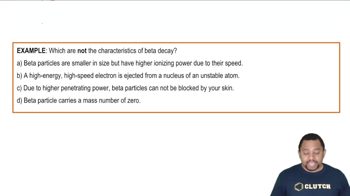
Characteristics of Beta Particles Example