Ch.6 Ionic and Molecular Compounds
Timberlake - Chemistry: An Introduction to General, Organic, and Biological Chemistry 13th Edition
Timberlake13th EditionChemistry: An Introduction to General, Organic, and Biological ChemistryISBN: 9780134421353Non è quello che usi tu?Cambia libro di testo
Capitolo 6, Problema 97c

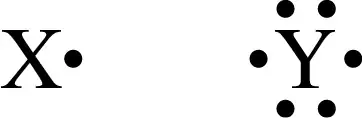
Consider the following Lewis symbols for elements X and Y:
Lewis dot symbols for elements X and Y, illustrating their valence electrons for ion formation analysis.
c. What ions would be formed by X and Y?

Guida verificata passo dopo passo
1
Step 1: Analyze the Lewis symbols provided in the image. The element 'M' has six valence electrons, represented by six dots around the symbol. The element 'N' has one valence electron, represented by a single dot around the symbol.
Step 2: Determine the electron configuration and stability of each element. Element 'M' needs two more electrons to complete its octet (8 valence electrons), while element 'N' needs to lose one electron to achieve a stable electron configuration.
Step 3: Predict the type of ions formed based on the electron transfer. Element 'M' will likely gain two electrons to form an anion with a charge of -2 (M²⁻), while element 'N' will lose one electron to form a cation with a charge of +1 (N⁺).
Step 4: Write the chemical symbols for the ions formed. The anion formed by 'M' is represented as M²⁻, and the cation formed by 'N' is represented as N⁺.
Step 5: Confirm the charges and stability of the ions. The transfer of electrons between 'M' and 'N' ensures that both achieve stable electron configurations, satisfying the octet rule for 'M' and the empty valence shell for 'N'.

Risposta video verificata per un problema simile:

Questa soluzione video è stata consigliata dai nostri tutor come utile per risolvere questo problema.
Durata del video:
3m

Concetti chiave

Ecco i concetti essenziali che devi comprendere per rispondere correttamente alla domanda.

Lewis Dot Structures

Lewis dot structures are diagrams that represent the valence electrons of an atom. Each dot corresponds to a valence electron, and the arrangement of these dots helps visualize how atoms bond and form ions. Understanding these structures is crucial for predicting the behavior of elements in chemical reactions, particularly in ion formation.
Video consigliato:
Percorso guidato
03:11
Lewis Dot Structures: Ions (Simplified) Concept 1

Ion Formation

Ions are charged particles that form when atoms gain or lose electrons. Metals typically lose electrons to form positively charged cations, while nonmetals gain electrons to form negatively charged anions. The ability to predict the ions formed by elements X and Y relies on their position in the periodic table and their respective valence electron configurations.
Video consigliato:
Percorso guidato
1:41
Amide Formation Concept 1

Valence Electrons

Valence electrons are the outermost electrons of an atom and play a key role in chemical bonding and reactivity. The number of valence electrons determines how an element interacts with others, including its tendency to gain, lose, or share electrons. Analyzing the valence electrons of elements X and Y will help in predicting the types of ions they will form.
Video consigliato:
Percorso guidato
01:55
Valence Electrons of Elements (Simplified) Concept 1