Ch.7 Chemical Quantities and Reactions
Timberlake - Chemistry: An Introduction to General, Organic, and Biological Chemistry 13th Edition
Timberlake13th EditionChemistry: An Introduction to General, Organic, and Biological ChemistryISBN: 9780134421353Non è quello che usi tu?Cambia libro di testo
Capitolo 7, Problema 97d

Identify the type of reaction for each of the following as combination, decomposition, single replacement, double replacement, or combustion:
d. Zinc replaces copper in Cu(NO3)2.

Guida verificata passo dopo passo
1
Step 1: Understand the problem. The question asks us to identify the type of reaction based on the description provided. The reaction involves zinc (Zn) replacing copper (Cu) in copper(II) nitrate, Cu(NO₃)₂.
Step 2: Recall the types of chemical reactions. A single replacement reaction occurs when one element replaces another in a compound. The general form is A + BC → AC + B, where A replaces B in the compound BC.
Step 3: Analyze the reaction. Zinc (Zn) is a more reactive metal than copper (Cu) and can replace it in the compound Cu(NO₃)₂. The products of the reaction would be zinc nitrate, Zn(NO₃)₂, and copper metal, Cu.
Step 4: Match the reaction to the definition of a single replacement reaction. Since zinc replaces copper in the compound, this fits the criteria for a single replacement reaction.
Step 5: Conclude that the reaction described is a single replacement reaction based on the analysis and the general reaction pattern.

Risposta video verificata per un problema simile:

Questa soluzione video è stata consigliata dai nostri tutor come utile per risolvere questo problema.
Durata del video:
1m

Concetti chiave

Ecco i concetti essenziali che devi comprendere per rispondere correttamente alla domanda.

Single Replacement Reaction

A single replacement reaction occurs when one element replaces another in a compound. In this type of reaction, an element and a compound react to form a new element and a new compound. For example, in the reaction where zinc replaces copper in Cu(NO₃)₂, zinc displaces copper, resulting in the formation of zinc nitrate and elemental copper.
Video consigliato:
Percorso guidato
1:30
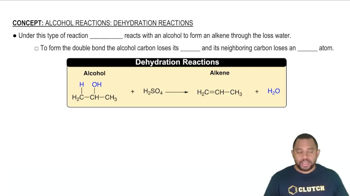
Alcohol Reactions: Dehydration Reactions Concept 1

Reactivity Series

The reactivity series is a list of metals arranged in order of decreasing reactivity. It helps predict whether a single replacement reaction will occur; a more reactive metal can displace a less reactive metal from its compound. In the case of zinc and copper, zinc is higher in the reactivity series than copper, indicating that zinc can successfully replace copper in the reaction.
Video consigliato:
Percorso guidato
2:14
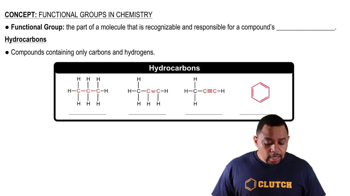
Hydrocarbons Concept 1

Chemical Equation

A chemical equation represents a chemical reaction using symbols and formulas. It shows the reactants on the left side and the products on the right side, with an arrow indicating the direction of the reaction. For the reaction of zinc with copper(II) nitrate, the balanced chemical equation would be Zn + Cu(NO₃)₂ → Zn(NO₃)₂ + Cu, illustrating the transformation of reactants into products.
Video consigliato:
Percorso guidato
01:32
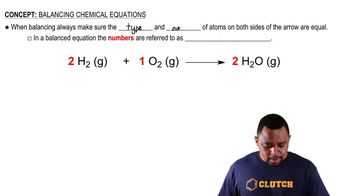
Balancing Chemical Equations (Simplified) Concept 1