
Ch.9 Solutions
Timberlake - Chemistry: An Introduction to General, Organic, and Biological Chemistry 13th Edition
Timberlake13th EditionChemistry: An Introduction to General, Organic, and Biological ChemistryISBN: 9780134421353Non è quello che usi tu?Cambia libro di testo
Capitolo 9, Problema 113c

In a laboratory experiment, a 10.0-mL sample of NaCl solution is poured into an evaporating dish with a mass of 24.10 g. The combined mass of the evaporating dish and NaCl solution is 36.15 g. After heating, the evaporating dish and dry NaCl have a combined mass of 25.50 g.
c. If water is added to 10.0 mL of the initial NaCl solution to give a final volume of 60.0 mL, what is the molarity of the diluted NaCl solution?

Guida verificata passo dopo passo
1
Step 1: Calculate the mass of the NaCl solution by subtracting the mass of the empty evaporating dish from the combined mass of the dish and solution. Use the formula: msolution = mdish+solution - mdish.
Step 2: Determine the mass of the NaCl solute by subtracting the mass of the empty evaporating dish from the combined mass of the dish and dry NaCl. Use the formula: msolute = mdish+dryNaCl - mdish.
Step 3: Calculate the mass percent of NaCl in the original solution using the formula: Mass percent=msolutemsolution×100.
Step 4: Use the mass of the NaCl solute and its molar mass (58.44 g/mol) to calculate the number of moles of NaCl in the original solution. Use the formula: nNaCl = msoluteMNaCl.
Step 5: Calculate the molarity of the diluted NaCl solution by dividing the moles of NaCl by the final volume of the solution (60.0 mL, converted to liters). Use the formula: Mdiluted = nNaClVsolution, where Vsolution is in liters.

Risposta video verificata per un problema simile:

Questa soluzione video è stata consigliata dai nostri tutor come utile per risolvere questo problema.
Durata del video:
3m

Concetti chiave

Ecco i concetti essenziali che devi comprendere per rispondere correttamente alla domanda.

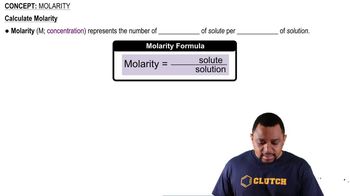
Molarity

Molarity is a measure of concentration defined as the number of moles of solute per liter of solution. It is expressed in moles per liter (mol/L). To calculate molarity, you need to know the amount of solute in moles and the total volume of the solution in liters. This concept is crucial for understanding how the concentration of a solution changes when it is diluted.
Video consigliato:

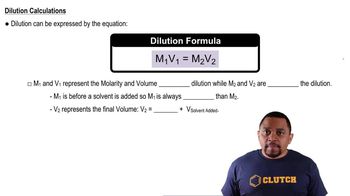
Dilution

Dilution is the process of reducing the concentration of a solute in a solution, typically by adding more solvent. When a solution is diluted, the number of moles of solute remains constant, but the volume increases, leading to a lower molarity. The dilution equation, M1V1 = M2V2, relates the initial and final molarity and volume, which is essential for solving dilution problems.
Video consigliato:

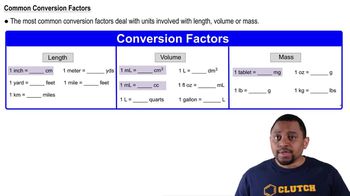
Volume Conversion

Volume conversion is the process of converting between different units of volume, such as milliliters (mL) and liters (L). In the context of molarity, it is important to express the total volume of the solution in liters since molarity is defined in terms of liters. Understanding how to convert between these units is necessary for accurately calculating the molarity of a solution after dilution.
Video consigliato:
Percorso guidato
02:10
Conversion Factors (Simplified) Concept 2