Ch.9 Solutions
Timberlake - Chemistry: An Introduction to General, Organic, and Biological Chemistry 13th Edition
Timberlake13th EditionChemistry: An Introduction to General, Organic, and Biological ChemistryISBN: 9780134421353Non è quello che usi tu?Cambia libro di testo
Capitolo 9, Problema 11b

Indicate whether aqueous solutions of each of the following solutes contain only ions, only molecules, or mostly molecules and a few ions:
b. NaBr, a strong electrolyte

Guida verificata passo dopo passo
1
Understand the concept of electrolytes: Electrolytes are substances that dissolve in water to produce ions. Strong electrolytes completely dissociate into ions in aqueous solutions, while weak electrolytes only partially dissociate, and non-electrolytes do not dissociate at all.
Identify the type of compound: NaBr (sodium bromide) is an ionic compound composed of a metal (Na⁺) and a nonmetal (Br⁻). Ionic compounds typically dissociate into ions when dissolved in water.
Determine the strength of the electrolyte: NaBr is classified as a strong electrolyte because it completely dissociates into its constituent ions (Na⁺ and Br⁻) in aqueous solution.
Write the dissociation equation: When NaBr dissolves in water, it dissociates completely as follows: NaBr(aq)→Na+(aq)+Br−(aq)
Conclude the type of species present: Since NaBr is a strong electrolyte and completely dissociates, the aqueous solution will contain only ions (Na⁺ and Br⁻) and no intact NaBr molecules.

Risposta video verificata per un problema simile:

Questa soluzione video è stata consigliata dai nostri tutor come utile per risolvere questo problema.
Durata del video:
1m

Concetti chiave

Ecco i concetti essenziali che devi comprendere per rispondere correttamente alla domanda.

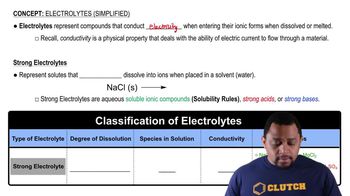
Strong Electrolytes

Strong electrolytes are substances that completely dissociate into ions when dissolved in water. This means that in an aqueous solution, they exist solely as ions, which can conduct electricity. Common examples include salts like sodium bromide (NaBr), which, when dissolved, separates into Na+ and Br- ions.
Video consigliato:
Percorso guidato
02:38
Electrolytes (Simplified) Concept 1

Dissociation in Aqueous Solutions

Dissociation refers to the process by which an ionic compound separates into its constituent ions in a solvent, typically water. In the case of NaBr, the ionic bonds between sodium and bromide ions break, allowing them to disperse throughout the solution as free-moving ions, which is essential for understanding the behavior of electrolytes in solution.
Video consigliato:

Ionic vs. Molecular Compounds

Ionic compounds, like NaBr, consist of charged ions and typically dissolve in water to form solutions containing only ions. In contrast, molecular compounds consist of molecules that do not dissociate into ions in solution. Understanding the difference between these types of compounds is crucial for predicting the composition of solutions and their electrical conductivity.
Video consigliato:
Percorso guidato
02:11
Naming Ionic Compounds