Ch.9 Solutions
Timberlake - Chemistry: An Introduction to General, Organic, and Biological Chemistry 13th Edition
Timberlake13th EditionChemistry: An Introduction to General, Organic, and Biological ChemistryISBN: 9780134421353Non è quello che usi tu?Cambia libro di testo
Capitolo 9, Problema 79a

Select the diagram that represents the solution formed by a solute <IMAGE> that is a (9.2)
a. nonelectrolyte
<IMAGE>

Guida verificata passo dopo passo
1
Step 1: Understand the concept of a nonelectrolyte. A nonelectrolyte is a substance that dissolves in water but does not dissociate into ions. This means the solution will contain only neutral molecules of the solute and no charged particles.
Step 2: Analyze the diagram provided. Look for representations of molecules in the solution. If the diagram shows individual molecules dispersed in the solvent without any indication of ions (charged particles), it may represent a nonelectrolyte solution.
Step 3: Compare the diagram to the characteristics of a nonelectrolyte solution. Ensure that the solute molecules are intact and not split into ions. This is a key feature of nonelectrolyte solutions.
Step 4: Consider the interaction between the solute and solvent. In a nonelectrolyte solution, the solute molecules interact with the solvent molecules through intermolecular forces, such as hydrogen bonding or van der Waals forces, but do not form ions.
Step 5: Select the diagram that best matches the description of a nonelectrolyte solution. Ensure that the diagram does not show any dissociation into ions and only depicts neutral solute molecules surrounded by solvent molecules.

Risposta video verificata per un problema simile:

Questa soluzione video è stata consigliata dai nostri tutor come utile per risolvere questo problema.
Durata del video:
4m

Concetti chiave

Ecco i concetti essenziali che devi comprendere per rispondere correttamente alla domanda.

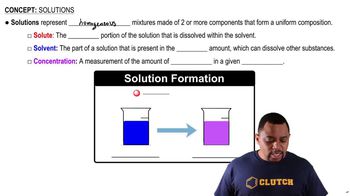
Solute and Solvent

In a solution, the solute is the substance that is dissolved, while the solvent is the medium in which the solute dissolves. For example, in a saltwater solution, salt is the solute and water is the solvent. Understanding the roles of solutes and solvents is crucial for analyzing how solutions form and behave.
Video consigliato:

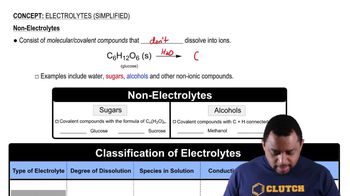
Electrolytes vs. Nonelectrolytes

Electrolytes are substances that dissociate into ions when dissolved in water, allowing the solution to conduct electricity. In contrast, nonelectrolytes do not dissociate into ions and do not conduct electricity. Recognizing the difference between these two types of solutes is essential for understanding their behavior in solutions.
Video consigliato:
Percorso guidato
02:11
Electrolytes (Simplified) Concept 3

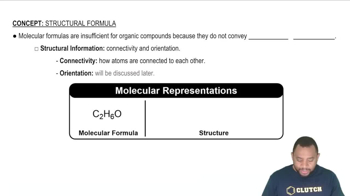
Molecular Representation of Solutions

Diagrams representing solutions often use spheres to symbolize solute and solvent molecules. The arrangement and interaction of these spheres can illustrate how solutes are distributed within a solvent. This visual representation aids in comprehending the molecular dynamics of solutions, particularly in distinguishing between different types of solutes.
Video consigliato:
Percorso guidato
2:08
Molecular Representations Concept 1