Ch.9 Solutions
Timberlake - Chemistry: An Introduction to General, Organic, and Biological Chemistry 13th Edition
Timberlake13th EditionChemistry: An Introduction to General, Organic, and Biological ChemistryISBN: 9780134421353Non è quello che usi tu?Cambia libro di testo
Capitolo 9, Problema 21b

When Michelle's blood was tested, the chloride level was 0.45 g/dL.
b. According to TABLE 9.6, is this value above, below, or within the normal range?

Guida verificata passo dopo passo
1
Refer to TABLE 9.6 to identify the normal range for chloride levels in blood. Typically, this range is expressed in g/dL.
Compare Michelle's chloride level (0.45 g/dL) to the normal range provided in TABLE 9.6.
Determine whether Michelle's chloride level falls below, within, or above the normal range by analyzing the numerical boundaries of the range.
If the value is below the lower limit, it is considered below the normal range. If it is above the upper limit, it is considered above the normal range. If it falls between the limits, it is within the normal range.
Conclude whether Michelle's chloride level is above, below, or within the normal range based on the comparison.

Risposta video verificata per un problema simile:

Questa soluzione video è stata consigliata dai nostri tutor come utile per risolvere questo problema.
Durata del video:
4m

Concetti chiave

Ecco i concetti essenziali che devi comprendere per rispondere correttamente alla domanda.

Normal Range of Chloride Levels

The normal range for chloride levels in the blood typically falls between 98 to 106 mEq/L (or approximately 3.5 to 4.5 g/dL). Understanding this range is crucial for interpreting whether a specific chloride level, such as Michelle's, is considered normal, elevated, or deficient.
Video consigliato:
Percorso guidato
02:35
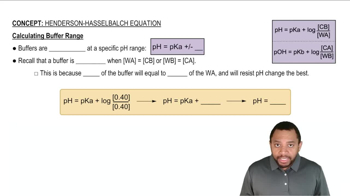
Calculating Buffer Range

Clinical Significance of Chloride Levels

Chloride is an essential electrolyte that helps maintain fluid balance, acid-base balance, and proper muscle and nerve function. Abnormal chloride levels can indicate various health issues, such as dehydration, kidney disease, or respiratory problems, making it important to assess these levels in a clinical context.
Video consigliato:
Percorso guidato
01:49
Significant Figures Precision Concept

Interpreting Laboratory Results

Interpreting laboratory results involves comparing a patient's test results against established reference ranges. This process helps healthcare professionals determine if the results indicate a health issue, require further testing, or are within normal limits, which is essential for accurate diagnosis and treatment planning.
Video consigliato:
Percorso guidato
05:30
Laboratory Materials 1