Ch.13 Carbohydrates
Timberlake - Chemistry: An Introduction to General, Organic, and Biological Chemistry 14th Edition
Timberlake14th EditionChemistry: An Introduction to General, Organic, and Biological ChemistryISBN: 9781292472249Non è quello che usi tu?Cambia libro di testo
Capitolo 13, Problema 77b

Gentiobiose is found in saffron.
b. Is gentiobiose a reducing sugar? Explain.

Guida verificata passo dopo passo
1
Step 1: Understand the definition of a reducing sugar. A reducing sugar is a carbohydrate that can act as a reducing agent because it has a free aldehyde group (-CHO) or a free ketone group (-C=O) in its structure. This is typically determined by the presence of a free anomeric carbon that is not involved in a glycosidic bond.
Step 2: Analyze the structure of gentiobiose. Gentiobiose is a disaccharide composed of two glucose molecules linked by a β(1→6) glycosidic bond. To determine if it is a reducing sugar, check if one of the glucose units has a free anomeric carbon.
Step 3: Identify the glycosidic bond in gentiobiose. The β(1→6) glycosidic bond connects the anomeric carbon of one glucose molecule to the hydroxyl group on the sixth carbon of the other glucose molecule. This means the anomeric carbon of one glucose is involved in the bond, but the other glucose molecule retains a free anomeric carbon.
Step 4: Determine if the free anomeric carbon can participate in redox reactions. Since one of the glucose units in gentiobiose has a free anomeric carbon, it can open up to form an aldehyde group, allowing it to act as a reducing sugar.
Step 5: Conclude that gentiobiose is a reducing sugar because it has a free anomeric carbon that can participate in redox reactions, fulfilling the criteria for a reducing sugar.

Risposta video verificata per un problema simile:

Questa soluzione video è stata consigliata dai nostri tutor come utile per risolvere questo problema.
Durata del video:
2m

Concetti chiave

Ecco i concetti essenziali che devi comprendere per rispondere correttamente alla domanda.

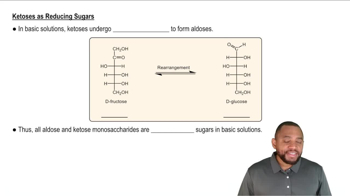
Reducing Sugars

Reducing sugars are carbohydrates that can donate electrons to other molecules, typically due to the presence of a free aldehyde or ketone group. This property allows them to reduce certain chemical reagents, such as Benedict's or Fehling's solutions, which is a key characteristic in identifying these sugars. Common examples include glucose and fructose.
Video consigliato:
Percorso guidato
1:03
Ketoses as Reducing Sugars Concept 2

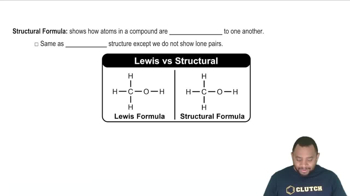
Structure of Gentiobiose

Gentiobiose is a disaccharide composed of two glucose units linked by a glycosidic bond. Its structure includes a free anomeric carbon on one of the glucose units, which is crucial for determining its reducing properties. The presence of this free anomeric carbon allows gentiobiose to act as a reducing sugar.
Video consigliato:
Percorso guidato
1:01
Structural Formula Concept 2

Chemical Tests for Reducing Sugars

Chemical tests, such as the Benedict's test, are used to identify reducing sugars by observing a color change when the sugar reduces copper(II) ions to copper(I) oxide. If gentiobiose is a reducing sugar, it will yield a positive result in these tests, indicating its ability to act as a reducing agent in solution.
Video consigliato:
Percorso guidato
1:01
Ketoses as Reducing Sugars Example 2