Ch.15 Lipids
Timberlake - Chemistry: An Introduction to General, Organic, and Biological Chemistry 14th Edition
Timberlake14th EditionChemistry: An Introduction to General, Organic, and Biological ChemistryISBN: 9781292472249Non è quello che usi tu?Cambia libro di testo
Capitolo 15, Problema 57

Which of the following are steroid hormones?
a. cholesterol
b. cortisol
c. estradiol
d. testosterone

Guida verificata passo dopo passo
1
Step 1: Understand the definition of steroid hormones. Steroid hormones are a class of hormones derived from cholesterol. They are characterized by their four-ring structure and are involved in various physiological processes such as metabolism, immune response, and reproduction.
Step 2: Analyze the given options. The options provided are cholesterol, cortisol, estradiol, and testosterone. Determine which of these are steroid hormones by identifying their chemical structure and biological role.
Step 3: Evaluate cholesterol. Cholesterol is a precursor molecule for steroid hormones but is not itself a hormone. It is used by the body to synthesize steroid hormones such as cortisol, estradiol, and testosterone.
Step 4: Evaluate cortisol, estradiol, and testosterone. Cortisol is a glucocorticoid hormone involved in stress response and metabolism. Estradiol is an estrogen hormone involved in reproductive processes. Testosterone is an androgen hormone involved in male reproductive development. All three are steroid hormones derived from cholesterol.
Step 5: Conclude that the steroid hormones in the list are cortisol, estradiol, and testosterone. Cholesterol is not a steroid hormone but a precursor for their synthesis.

Risposta video verificata per un problema simile:

Questa soluzione video è stata consigliata dai nostri tutor come utile per risolvere questo problema.
Durata del video:
1m

Concetti chiave

Ecco i concetti essenziali che devi comprendere per rispondere correttamente alla domanda.

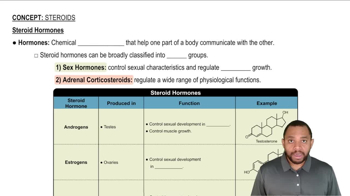
Steroid Hormones

Steroid hormones are a class of hormones derived from cholesterol, characterized by their lipid-soluble nature. They play crucial roles in regulating various physiological processes, including metabolism, immune response, and reproductive functions. Common examples include cortisol, estradiol, and testosterone, which are synthesized in the adrenal glands and gonads.
Video consigliato:
Percorso guidato
3:52
Steroids Concept 4

Cholesterol

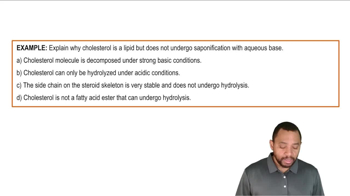
Cholesterol is a type of lipid molecule that serves as a fundamental building block for the synthesis of steroid hormones. While it is essential for hormone production, cholesterol itself is not classified as a steroid hormone. Instead, it is a precursor that undergoes enzymatic conversion to form various steroid hormones in the body.
Video consigliato:
Percorso guidato
1:35
Steroids Example 1

Hormonal Functions

Hormonal functions refer to the diverse roles that hormones play in the body, including regulation of metabolism, growth, and reproduction. Steroid hormones, in particular, can influence gene expression by binding to specific receptors in target cells, leading to changes in cellular activity. Understanding these functions is key to recognizing the importance of hormones like cortisol, estradiol, and testosterone in maintaining homeostasis.
Video consigliato:
Percorso guidato
02:16
Logarithmic Functions