Indietro
Problema 99
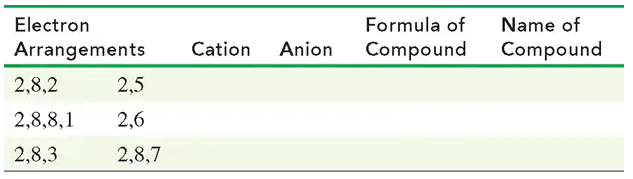
Using each of the following electron arrangements, give the formulas for the cation and anion that form, the formula for the compound they form, and its name.
Problema 102c
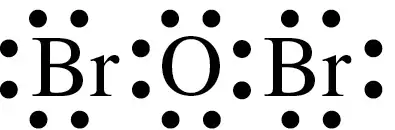
State the number of valence electrons, bonding pairs, and lone pairs in each of the following Lewis structures:
c.
Problema 103c
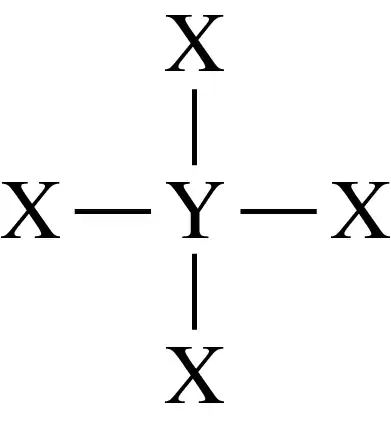
Match each of the Lewis structures (a to c) with the correct diagram (1 to 3) of its shape, and name the shape; indicate if each molecule is polar or nonpolar. Assume X and Y are nonmetals and all bonds are polar covalent.
<IMAGE>
c.
Problema 104a
Match each of the formulas (a to c) with the correct diagram (1 to 3) of its shape, and name the shape; indicate if each molecule is polar or nonpolar.
<IMAGE>
a. PBr3
Problema 105d
Consider the following bonds: Ca and O, C and O, K and O, O and O, and N and O.
d. Arrange the covalent bonds in order of decreasing polarity.
Problema 111b
Consider an ion with the symbol X2+ formed from a representative element.
b. What is the Lewis symbol of the element?
Problema 111c
Consider an ion with the symbol X2+ formed from a representative element.
c. If X is in Period 3, what is the element?
Problema 111d
Consider an ion with the symbol X2+ formed from a representative element.
d. What is the formula of the compound formed from X and the nitride ion?
Problema 112b
Consider an ion with the symbol Y3- formed from a representative element.
b. What is the Lewis symbol of the element?
Problema 112c
Consider an ion with the symbol Y3- formed from a representative element.
c. If Y is in Period 3, what is the element?
Problema 113a
One of the ions of tin is tin(IV).
a. What is the symbol for this ion?
Problema 113b
One of the ions of tin is tin(IV).
b. How many protons and electrons are in the ion?
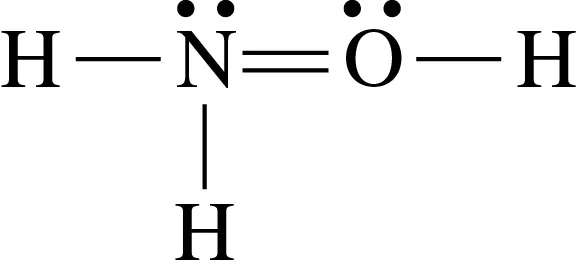
Problema 127b
Draw the Lewis structure for each of the following:
b. H2NOH (N is the central atom)
Problema 128a
Draw the Lewis structure for each of the following:
a. H3COCH3 (the atoms are in the order C O C)
Problema 131c
Select the more polar bond in each of the following pairs:
c. Br―Cl or S―Cl
Problema 133a
Show the dipole arrow for each of the following bonds:
a. Si―Cl
Problema 135a
Calculate the electronegativity difference and classify each of the following bonds as nonpolar covalent, polar covalent, or ionic:
a. Si and Cl
Problema 135b
Calculate the electronegativity difference and classify each of the following bonds as nonpolar covalent, polar covalent, or ionic:
b. C and C
Problema 135c
Calculate the electronegativity difference and classify each of the following bonds as nonpolar covalent, polar covalent, or ionic:
c. Na and Cl
Problema 141a
Predict the shape and polarity of each of the following molecules, which have polar covalent bonds:
a. A central atom with three identical bonded atoms and one lone pair.
Problema 149a
Identify the group number in the periodic table of X, a representative element, in each of the following ionic compounds:
a. XCl3
Problema 149b
Identify the group number in the periodic table of X, a representative element, in each of the following ionic compounds:
b. Al2X3
Problema 150b
Identify the group number in the periodic table of X, a representative element, in each of the following ionic compounds:
b. X2SO3
Problema 151c
Classify each of the following as ionic or molecular, and name each:
a. Li2HPO4
Problema 152b
Classify each of the following as ionic or molecular, and name each:
b. Cl2O7
Problema 153a
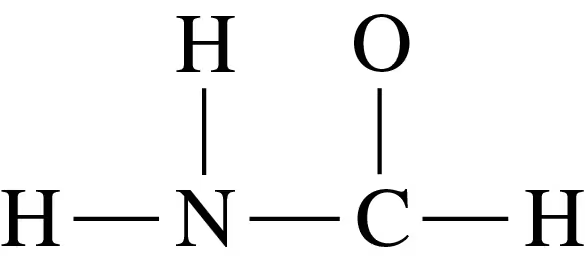
Complete the Lewis structure for each of the following:
a.
Problema 154c
Identify the errors in each of the following Lewis structures and draw the correct formula:
c.