Ch.9 Solutions
Timberlake - Chemistry: An Introduction to General, Organic, and Biological Chemistry 14th Edition
Timberlake14th EditionChemistry: An Introduction to General, Organic, and Biological ChemistryISBN: 9781292472249Non è quello che usi tu?Cambia libro di testo
Capitolo 9, Problema 19

An intravenous solution contains 40. mEq/L of Cl– and 15 mEq/L of HPO42–. If Na+ is the only cation in the solution, what is the Na+ concentration, in milliequivalents per liter?

Guida verificata passo dopo passo
1
Understand the problem: The solution contains two anions, Cl⁻ and HPO₄²⁻, with concentrations given in milliequivalents per liter (mEq/L). Since Na⁺ is the only cation, its concentration must balance the total charge contributed by the anions to maintain electrical neutrality.
Calculate the total negative charge contributed by the anions. Add the milliequivalents per liter of Cl⁻ and HPO₄²⁻, taking into account their charges. For Cl⁻, the charge is -1, and for HPO₄²⁻, the charge is -2. However, the mEq/L values already account for these charges, so simply sum the given values: 40 mEq/L (Cl⁻) + 15 mEq/L (HPO₄²⁻).
Recognize that the total positive charge contributed by Na⁺ must equal the total negative charge from the anions. Therefore, the Na⁺ concentration in mEq/L will be equal to the total negative charge calculated in the previous step.
Express the Na⁺ concentration in milliequivalents per liter (mEq/L), as this is the unit requested in the problem. Since the solution is electrically neutral, the Na⁺ concentration will directly match the total negative charge.
Verify the solution by ensuring that the total positive charge (from Na⁺) equals the total negative charge (from Cl⁻ and HPO₄²⁻). This confirms that the solution is electrically neutral, as required.

Risposta video verificata per un problema simile:

Questa soluzione video è stata consigliata dai nostri tutor come utile per risolvere questo problema.
Durata del video:
2m

Concetti chiave

Ecco i concetti essenziali che devi comprendere per rispondere correttamente alla domanda.

Milliequivalents (mEq)

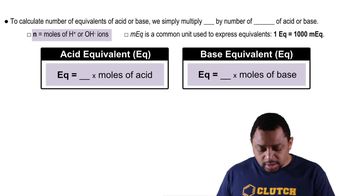
Milliequivalents (mEq) is a unit of measure used in chemistry and medicine to express the amount of a substance based on its chemical activity. It accounts for the valence of ions, allowing for the comparison of different ions in terms of their ability to react. For example, 1 mEq of Na⁺ is equivalent to 1 mEq of Cl⁻ because both have a valence of 1.
Video consigliato:
Percorso guidato
00:46
Acid-Base Equivalents Concept 2

Electroneutrality Principle

The electroneutrality principle states that in a solution, the total positive charge must equal the total negative charge. This principle is crucial for calculating ion concentrations in solutions, as it ensures that the solution remains electrically neutral. In this case, the concentration of Na⁺ must balance the concentrations of Cl⁻ and HPO₄²⁻ to maintain electroneutrality.
Video consigliato:
Percorso guidato
09:34
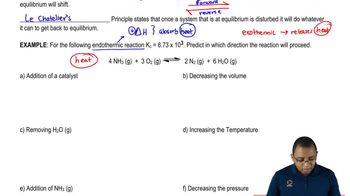
The following is an endothermic reaction where Kc = 6.73 x 10³.For each of the choices below predict in which direction the reaction will proceed

Ion Concentration Calculation

Calculating ion concentration involves determining the amount of each ion present in a solution, often expressed in milliequivalents per liter (mEq/L). In this scenario, to find the Na⁺ concentration, one must sum the negative charges from Cl⁻ and HPO₄²⁻ and set this equal to the Na⁺ concentration, as it is the only cation present. This calculation is essential for understanding the overall ionic balance in intravenous solutions.
Video consigliato:
Percorso guidato
00:52
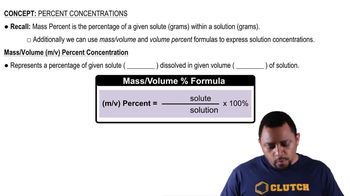
Percent Concentrations Concept 1