 Indietro
Microbial Genetics: Structure, Function, and Regulation of Genetic Material
Guida di studio - Note intelligenti
 Appunti personalizzati basati sui tuoi materiali, ampliati con definizioni chiave, esempi e contesto.
Microbial Genetics
Introduction to Microbial Genetics
Microbial genetics is the study of how microorganisms inherit traits, how their genetic information is organized, expressed, and regulated, and how genetic changes drive microbial diversity and evolution. Understanding microbial genetics is essential for applications in medicine, biotechnology, and understanding microbial physiology.
Genetics: The science of heredity, including the study of genes, gene expression, and gene replication.
Genome: The complete set of genetic information in a cell.
Chromosome: Structures containing DNA that carry hereditary information.
Gene: Segments of DNA that encode functional products, usually proteins.
Genetic code: The set of rules by which nucleotide sequences are translated into amino acid sequences of proteins.
Genotype: The genetic makeup of an organism.
Phenotype: The observable expression of genes.
Genomics: The sequencing and molecular characterization of genomes.
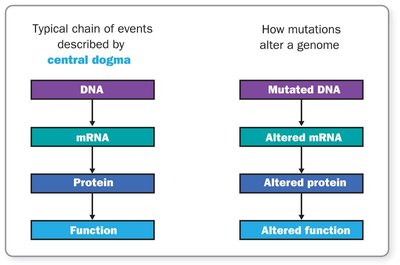
Structure and Function of Genetic Material
DNA and Chromosomes
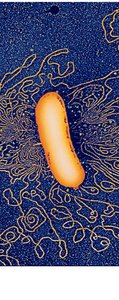
Bacteria typically possess a single, circular chromosome located in the nucleoid region, along with extrachromosomal DNA elements called plasmids. The bacterial genome includes both protein-coding genes and noncoding regions such as short tandem repeats (STRs).
Chromosomal DNA: Contains essential genes for survival and replication.
Plasmid DNA: Small, circular DNA molecules that often carry genes for antibiotic resistance or other specialized functions.
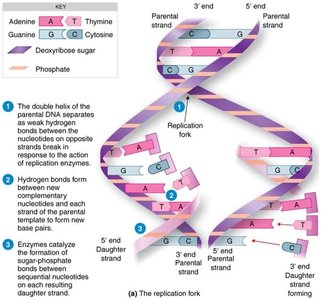
DNA Structure
DNA is a double helix composed of two antiparallel strands of nucleotides. The strands are held together by hydrogen bonds between complementary bases: adenine (A) pairs with thymine (T), and cytosine (C) pairs with guanine (G).
The sugar-phosphate backbone provides structural support.
The order of nitrogenous bases encodes genetic information.

Flow of Genetic Information
Central Dogma of Molecular Biology
The central dogma describes the flow of genetic information from DNA to RNA to protein. This process involves transcription (DNA to mRNA) and translation (mRNA to protein).
Replication: DNA is copied to pass genetic information to the next generation.
Transcription: DNA is transcribed into messenger RNA (mRNA).
Translation: mRNA is translated into a protein sequence.

Vertical and Horizontal Gene Transfer
Genetic information can be transferred vertically (from parent to offspring) or horizontally (between cells of the same generation), contributing to genetic diversity and evolution.
Vertical gene transfer: Transmission of genetic material from parent to progeny.
Horizontal gene transfer: Exchange of genetic material between unrelated cells.

DNA Replication
Mechanism of DNA Replication
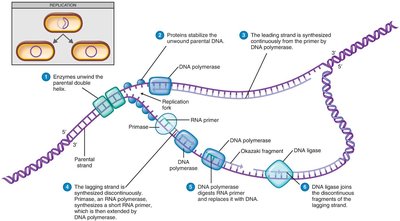
DNA replication is a semi-conservative process where each strand serves as a template for a new strand. Key enzymes include DNA polymerase, helicase, primase, ligase, and gyrase.
Initiation: Helicase unwinds the DNA helix, and primase synthesizes RNA primers.
Elongation: DNA polymerase adds nucleotides in the 5' to 3' direction. The leading strand is synthesized continuously, while the lagging strand is synthesized in Okazaki fragments.
Termination: DNA ligase joins Okazaki fragments, completing the new DNA molecule.
RNA and Protein Synthesis
Types of RNA
mRNA (messenger RNA): Carries genetic information from DNA to ribosomes.
tRNA (transfer RNA): Brings amino acids to the ribosome during translation.
rRNA (ribosomal RNA): Integral part of ribosome structure and function.
Transcription (DNA to RNA)
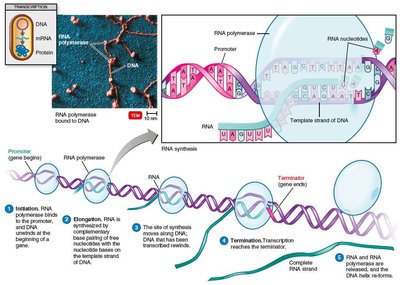
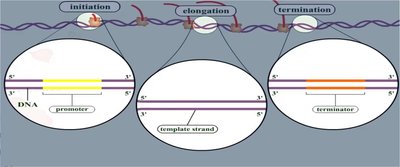
Transcription is the synthesis of a complementary mRNA strand from a DNA template. It involves three main steps: initiation, elongation, and termination.
Initiation: RNA polymerase binds to the promoter region of DNA.
Elongation: RNA polymerase synthesizes RNA in the 5' to 3' direction.
Termination: Transcription ends when the terminator sequence is reached.
Translation (RNA to Protein)
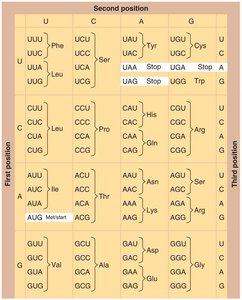
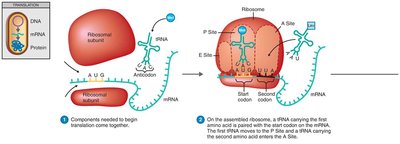
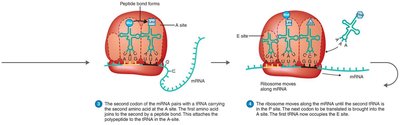
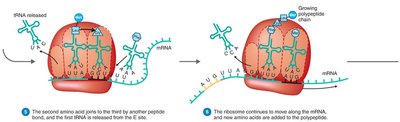
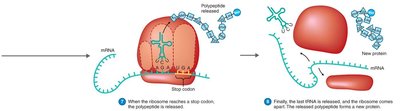
Translation is the process by which ribosomes synthesize proteins using the sequence of codons in mRNA. Each codon (three nucleotides) specifies an amino acid.
Start codon: AUG (methionine)
Stop codons: UAA, UAG, UGA
Degeneracy: Most amino acids are encoded by more than one codon.
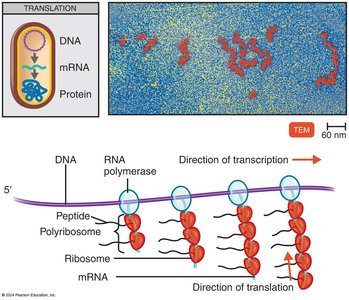
Simultaneous Transcription and Translation in Bacteria
In prokaryotes, transcription and translation can occur simultaneously in the cytoplasm, allowing rapid protein synthesis.
Transcription in Eukaryotes
In eukaryotes, transcription occurs in the nucleus and involves the removal of introns (noncoding regions) from the pre-mRNA. Exons (coding regions) are spliced together to form mature mRNA, which is then exported to the cytoplasm for translation.
Regulation of Gene Expression
Operons and Gene Regulation in Bacteria
Gene expression in bacteria is often regulated by operons, which are clusters of genes transcribed together and controlled by a single promoter and operator.
Inducible operon: Genes are off unless an inducer is present (e.g., lac operon).
Repressible operon: Genes are on unless a corepressor is present (e.g., trp operon).
Positive and Epigenetic Regulation
Catabolite repression: Inhibits the use of alternative carbon sources when glucose is present. cAMP and CAP are involved in activating the lac operon when glucose is scarce.
Epigenetic control: Methylation of DNA can turn genes off, and these modifications can be inherited but are reversible.
Post-Transcriptional Control
Riboswitches: Regulatory segments of mRNA that bind small molecules and alter mRNA structure, affecting translation.
microRNAs (miRNAs): Small RNAs that bind to mRNA, causing its degradation or blocking translation.
Mutations and Genetic Variation
Types of Mutations
Silent mutation: No effect on protein function.
Missense mutation: Changes one amino acid in the protein.
Nonsense mutation: Introduces a stop codon, truncating the protein.
Frameshift mutation: Insertion or deletion of nucleotides shifts the reading frame, altering downstream amino acids.
Mutagenesis and DNA Repair
Mutagens: Agents that increase mutation rates (e.g., chemicals, radiation).
DNA repair mechanisms: Include photolyase-mediated repair of thymine dimers and nucleotide excision repair.
Genetic Transfer and Recombination
Plasmids and Transposons
Plasmids: Self-replicating, extrachromosomal DNA elements that may carry genes for antibiotic resistance, toxin production, or metabolic functions.
Transposons: Mobile DNA segments that can move within and between DNA molecules, sometimes carrying additional genes such as antibiotic resistance.
Mechanisms of Horizontal Gene Transfer
Transformation: Uptake of naked DNA from the environment by a bacterial cell.
Conjugation: Transfer of DNA between bacteria via direct cell-to-cell contact, often involving plasmids.
Transduction: Transfer of bacterial DNA by bacteriophages (viruses that infect bacteria).
Genetic Recombination
Genetic recombination involves the exchange of genetic material between different DNA molecules, increasing genetic diversity and providing material for natural selection.
Summary Table: Key Enzymes in DNA Replication and Expression
Enzyme | Function |
|---|---|
DNA Polymerase | Synthesizes DNA, proofreads, and repairs DNA |
Helicase | Unwinds double-stranded DNA |
Ligase | Joins DNA fragments (Okazaki fragments) |
Primase | Synthesizes RNA primers |
Gyrase/Topoisomerase | Relaxes supercoiling ahead of replication fork |
Endonuclease/Exonuclease | Cut DNA for repair and recombination |
Additional info: This guide covers the essential concepts of microbial genetics, including the structure and function of genetic material, mechanisms of gene expression and regulation, types of mutations, and genetic exchange in bacteria. These principles are foundational for understanding microbial physiology, evolution, and biotechnology applications.
