

Ch. 13 - Characterizing and Classifying Viruses, Viroids, and Prions
Bauman - Microbiology with Diseases by Taxonomy 6th Edition
Bauman6th EditionMicrobiology with Diseases by TaxonomyISBN: 9780134832302Non è quello che usi tu?Cambia libro di testo
Capitolo 13, Problema 5

Which of the following statements is false?
a. Viruses may have circular DNA.
b. dsRNA is found in bacteria more often than in viruses.
c. Viral DNA may be linear.
d. Typically, viruses have DNA or RNA but not both.

Guida verificata passo dopo passo
1
Step 1: Understand the nature of viral genomes. Viruses can have DNA or RNA as their genetic material, and this can be either single-stranded or double-stranded. Additionally, viral DNA can be either circular or linear.
Step 2: Analyze statement (a): 'Viruses may have circular DNA.' This is true because some viruses, such as certain bacteriophages and animal viruses, have circular DNA genomes.
Step 3: Analyze statement (b): 'dsRNA is found in bacteria more often than in viruses.' This requires understanding that double-stranded RNA (dsRNA) genomes are characteristic of some viruses, but dsRNA is not commonly found in bacteria. Bacteria typically have double-stranded DNA genomes, not dsRNA.
Step 4: Analyze statement (c): 'Viral DNA may be linear.' This is true because many viruses, including some bacteriophages and animal viruses, have linear DNA genomes.
Step 5: Analyze statement (d): 'Typically, viruses have DNA or RNA but not both.' This is true; viruses generally contain either DNA or RNA as their genetic material, but not both simultaneously.

Risposta video verificata per un problema simile:

Questa soluzione video è stata consigliata dai nostri tutor come utile per risolvere questo problema.
Durata del video:
1m

Concetti chiave

Ecco i concetti essenziali che devi comprendere per rispondere correttamente alla domanda.

Viral Genome Structure

Viruses can have genomes made of DNA or RNA, which may be single-stranded or double-stranded, and can be linear or circular. Understanding the diversity in viral genome structures helps in identifying viral types and their replication mechanisms.
Video consigliato:
03:18
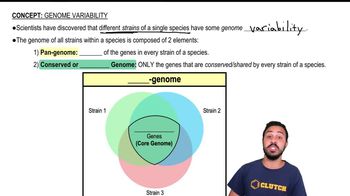
Genome Variability

Double-Stranded RNA (dsRNA) in Microorganisms

Double-stranded RNA is uncommon in bacteria but is a characteristic feature of some viruses. Most bacteria have double-stranded DNA genomes, while dsRNA viruses use this form as their genetic material, making dsRNA more typical in viruses than bacteria.
Video consigliato:
04:28
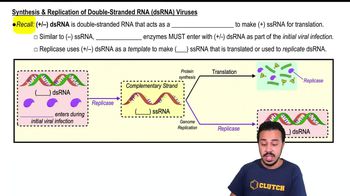
Replication of Double-Stranded RNA Viruses

Mutual Exclusivity of Viral Nucleic Acids

Viruses typically contain either DNA or RNA as their genetic material, but not both simultaneously. This exclusivity is a fundamental principle in virology, distinguishing viral types and influencing their replication strategies.
Video consigliato:
03:22
Nucleic Acids