Ch. 17 - Immunization and Immune Testing
Bauman - Microbiology with Diseases by Taxonomy 6th Edition
Bauman6th EditionMicrobiology with Diseases by TaxonomyISBN: 9780134832302Non è quello che usi tu?Cambia libro di testo
Capitolo 17, Problema 4

When antigen and antibodies combine, maximal precipitation occurs when:
a. Antigen is in excess
b. Antibody is in excess
c. Antigen and antibody are at equivalent concentrations
d. Antigen is added to the antibody

Guida verificata passo dopo passo
1
Understand the concept of antigen-antibody precipitation: This occurs when soluble antigens and antibodies form complexes that become large enough to precipitate out of solution.
Recall the equivalence zone in immunology, where the optimal ratio of antigen to antibody leads to maximal lattice formation and precipitation.
Recognize that when antigen and antibody concentrations are equivalent, the largest immune complexes form, leading to maximal precipitation.
Consider what happens when either antigen or antibody is in excess: excess antigen or antibody prevents optimal cross-linking, reducing precipitation.
Conclude that maximal precipitation occurs when antigen and antibody are at equivalent concentrations, corresponding to option c.

Risposta video verificata per un problema simile:

Questa soluzione video è stata consigliata dai nostri tutor come utile per risolvere questo problema.
Durata del video:
3m

Concetti chiave

Ecco i concetti essenziali che devi comprendere per rispondere correttamente alla domanda.

Antigen-Antibody Interaction

Antigens are molecules that elicit an immune response, while antibodies are proteins that specifically bind to antigens. Their interaction forms immune complexes, which can lead to visible reactions such as precipitation or agglutination, depending on the nature and concentration of each component.
Video consigliato:
09:16
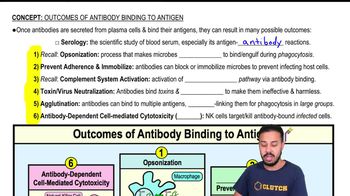
Outcomes of Antibody Binding to Antigen

Precipitation Reaction

Precipitation occurs when soluble antigens and antibodies form large, insoluble complexes that settle out of solution. This reaction depends on the optimal ratio of antigen to antibody, allowing cross-linking and lattice formation necessary for visible precipitate.
Video consigliato:
01:56
Chemical Reactions

Equivalence Zone in Immunoprecipitation

The equivalence zone is the point where antigen and antibody concentrations are roughly equal, maximizing lattice formation and precipitation. Outside this zone, either antigen or antibody excess prevents optimal cross-linking, reducing or preventing visible precipitation.
Video consigliato:
04:34
Differential Media