Ch. 25 - Pathogenic RNA Viruses
Bauman - Microbiology with Diseases by Taxonomy 6th Edition
Bauman6th EditionMicrobiology with Diseases by TaxonomyISBN: 9780134832302Non è quello che usi tu?Cambia libro di testo
Capitolo 25, Problema 1

_____A single virion is sufficient to cause a cold.

Guida verificata passo dopo passo
1
Understand the term 'virion': A virion is a complete virus particle that consists of an RNA or DNA core with a protein coat and is the extracellular infective form of a virus.
Recognize the infectious dose concept: The infectious dose is the number of virions required to establish an infection in a host.
Consider the nature of the common cold virus (usually rhinovirus): It is known for its high infectivity, meaning very few virions are needed to cause infection.
Analyze the statement: 'A single virion is sufficient to cause a cold' implies that even one virus particle can initiate infection, which relates to the minimal infectious dose.
Conclude that the statement is about the minimal infectious dose and the high infectivity of cold viruses, emphasizing that sometimes even one virion can start the infection process.

Risposta video verificata per un problema simile:

Questa soluzione video è stata consigliata dai nostri tutor come utile per risolvere questo problema.
Durata del video:
1m

Concetti chiave

Ecco i concetti essenziali che devi comprendere per rispondere correttamente alla domanda.

Virion and Virus Structure

A virion is the complete, infectious form of a virus outside a host cell, consisting of genetic material enclosed in a protein coat. Understanding the virion's structure helps explain how viruses infect host cells and initiate disease.
Video consigliato:
02:33
Introduction to Animal Virus Infections

Infectious Dose

The infectious dose is the minimum number of viral particles required to establish an infection. Some viruses, like those causing the common cold, can cause infection with very few virions, sometimes even a single one.
Video consigliato:
05:09
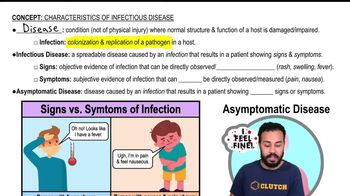
Intro to Characteristics of Infectious Disease

Pathogenesis of the Common Cold

The common cold is caused primarily by rhinoviruses, which infect the upper respiratory tract. Their ability to cause infection from a low number of virions is linked to their rapid replication and evasion of the immune response.
Video consigliato:
02:35
Intro to Bacterial Pathogenesis
Pratica correlata
Domanda del libro di testo

Why are humans considered “dead-end” hosts for many arboviruses?

1636
views

Domanda del libro di testo

Young Luis has skin lesions. His mother knows from microbiology class that five childhood diseases can produce spots. Name those five diseases and the viruses that cause each. List some questions to ask to determine which of these viruses Luis has.

1091
views
Domanda del libro di testo

What viral family causes each of these diseases? (A family may be used more than once.)


1. _____Myocarditis

2. _____Colorado tick fever

3. _____Rabies

4. _____Influenza

5. _____Dengue fever

6. _____German measles

7. _____Acute gastroenteritis

8. _____Ebola virus

9. _____RSV

10. _____Western equine encephalitis

11. _____No known disease


A. Rhabdoviridae

B. Paramyxoviridae

C. Reoviridae

D. Coronaviridae

E. Togaviridae

F. Flaviviridae

G. Orthomyxoviridae

H. Orphan virus

I. Caliciviridae

J. Filoviridae

K. Picornaviridae

1126
views
Domanda del libro di testo

Label the steps in retroviral replication shown for HIV.

<IMAGE>

59
views
Domanda del libro di testo

A segmented genome is one that has __________.


a. more than one strand of nucleic acid

b. double-stranded RNA

c. both RNA and DNA strands

d. both +ssRNA and -ssRNA molecules

1604
views
Domanda del libro di testo

What do viruses in the families Picornaviridae, Caliciviridae, Astroviridae, Coronaviridae, Togaviridae, Flaviviridae, and Retroviridae have in common?


a. They are arboviruses.

b. They are nonpathogenic.

c. They have positive single-stranded RNA genomes.

d. They have negative single-stranded RNA genomes.

1269
views