Why are humans considered “dead-end” hosts for many arboviruses?
Ch. 25 - Pathogenic RNA Viruses
Bauman6th EditionMicrobiology with Diseases by TaxonomyISBN: 9780134832302Non è quello che usi tu?Cambia libro di testo
Capitolo 25, Problema 1
Label the steps in retroviral replication shown for HIV.
<IMAGE>
Guida verificata passo dopo passo1
Identify the initial step where the HIV virus attaches to the host cell by binding its envelope glycoproteins to the CD4 receptor and a co-receptor on the host cell surface. This is called viral attachment and entry.
Next, recognize the fusion of the viral envelope with the host cell membrane, allowing the viral capsid to enter the cytoplasm. This step is viral fusion and uncoating.
Then, focus on the reverse transcription process where the viral RNA genome is converted into double-stranded DNA by the enzyme reverse transcriptase carried within the virus.
After reverse transcription, the newly synthesized viral DNA is transported into the host cell nucleus and integrated into the host genome by the viral enzyme integrase. This step is called integration.
Finally, understand that the integrated viral DNA (provirus) is transcribed and translated by the host machinery to produce new viral RNA genomes and proteins, which assemble into new virions that bud from the host cell to infect other cells.

Risposta video verificata per un problema simile:
Questa soluzione video è stata consigliata dai nostri tutor come utile per risolvere questo problema.
Durata del video:
1mConcetti chiave
Ecco i concetti essenziali che devi comprendere per rispondere correttamente alla domanda.
Retroviral Genome and Entry
Retroviruses like HIV carry their genetic material as RNA. Upon infecting a host cell, the virus binds to specific receptors and fuses with the cell membrane, allowing the viral RNA to enter the cytoplasm. Understanding this initial step is crucial for tracing the replication process.
Video consigliato:
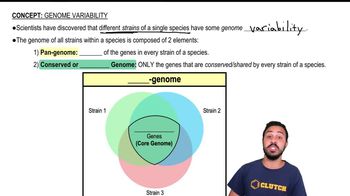
Genome Variability
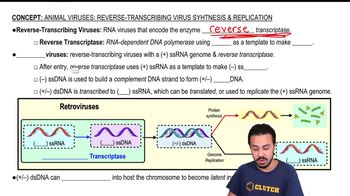
Reverse Transcription
Once inside the host cell, HIV uses the enzyme reverse transcriptase to convert its single-stranded RNA genome into double-stranded DNA. This step is unique to retroviruses and is essential for integrating viral DNA into the host genome.
Video consigliato:
Animal Viruses: Reverse-Transcribing Virus Synthesis & Replication
Integration and Viral Assembly
The newly synthesized viral DNA is transported into the nucleus and integrated into the host's genome by the integrase enzyme. The host machinery then transcribes and translates viral proteins, which assemble into new virions that bud off to infect other cells.
Video consigliato:
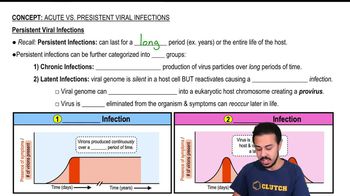
Persistent Viral Infections
Pratica correlata
Domanda del libro di testo
1636
views
Domanda del libro di testo
What viral family causes each of these diseases? (A family may be used more than once.)
1. _____Myocarditis
2. _____Colorado tick fever
3. _____Rabies
4. _____Influenza
5. _____Dengue fever
6. _____German measles
7. _____Acute gastroenteritis
8. _____Ebola virus
9. _____RSV
10. _____Western equine encephalitis
11. _____No known disease
A. Rhabdoviridae
B. Paramyxoviridae
C. Reoviridae
D. Coronaviridae
E. Togaviridae
F. Flaviviridae
G. Orthomyxoviridae
H. Orphan virus
I. Caliciviridae
J. Filoviridae
K. Picornaviridae
1126
views
Domanda del libro di testo
_____A single virion is sufficient to cause a cold.
1381
views
Domanda del libro di testo
A segmented genome is one that has __________.
a. more than one strand of nucleic acid
b. double-stranded RNA
c. both RNA and DNA strands
d. both +ssRNA and -ssRNA molecules
1604
views