Ch. 3 - Cell Structure and Function
Bauman - Microbiology with Diseases by Taxonomy 6th Edition
Bauman6th EditionMicrobiology with Diseases by TaxonomyISBN: 9780134832302Non è quello che usi tu?Cambia libro di testo
Capitolo 3, Problema 14

What factors may prevent a molecule from moving across a cell membrane?

Guida verificata passo dopo passo
1
Understand that the cell membrane is selectively permeable, meaning it allows some molecules to pass while blocking others based on specific factors.
Consider the size of the molecule: large molecules generally cannot pass through the membrane easily, while small molecules can move more freely.
Examine the polarity and charge of the molecule: nonpolar and uncharged molecules tend to cross the lipid bilayer more readily than polar or charged molecules, which are often repelled or require special transport mechanisms.
Recognize the role of membrane proteins: some molecules need specific transport proteins (channels or carriers) to cross the membrane, so the absence of these proteins can prevent movement.
Account for concentration gradients and energy requirements: molecules may not move if there is no favorable concentration gradient or if active transport is needed but energy (ATP) is unavailable.

Risposta video verificata per un problema simile:

Questa soluzione video è stata consigliata dai nostri tutor come utile per risolvere questo problema.
Durata del video:
4m

Concetti chiave

Ecco i concetti essenziali che devi comprendere per rispondere correttamente alla domanda.

Cell Membrane Structure

The cell membrane is a phospholipid bilayer with embedded proteins, creating a semi-permeable barrier. Its hydrophobic core restricts the passage of polar or large molecules, allowing mainly small, nonpolar molecules to diffuse freely.
Video consigliato:
03:59
Archaeal Cell Membranes

Molecule Properties

Factors such as size, polarity, and charge influence a molecule's ability to cross the membrane. Large, charged, or polar molecules typically cannot pass through the lipid bilayer without assistance from transport proteins.
Video consigliato:
04:07
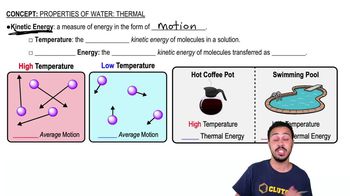
Properties of Water- Thermal

Transport Mechanisms

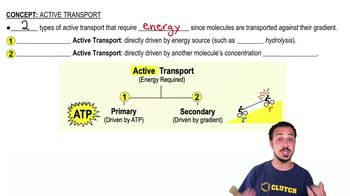
Movement across membranes can be passive or active. Passive diffusion requires no energy but is limited by molecule properties, while facilitated diffusion and active transport use proteins to help molecules cross, overcoming barriers like charge or size.
Video consigliato:
02:37
Active Transport