Ch. 3 - Cell Structure and Function
Bauman - Microbiology with Diseases by Taxonomy 6th Edition
Bauman6th EditionMicrobiology with Diseases by TaxonomyISBN: 9780134832302Non è quello che usi tu?Cambia libro di testo
Capitolo 3, Problema 13

What is the function of glycocalyces and fimbriae in forming a biofilm?

Guida verificata passo dopo passo
1
Understand that both glycocalyces and fimbriae are surface structures found on bacterial cells that play crucial roles in biofilm formation.
Recognize that glycocalyces, which include capsules and slime layers, primarily function to help bacteria adhere to surfaces and to each other, providing a sticky matrix that holds the biofilm together.
Know that fimbriae are hair-like appendages that facilitate the initial attachment of bacterial cells to surfaces and to neighboring cells, promoting close cell-to-cell interactions.
Combine these roles by explaining that glycocalyces create a protective and adhesive environment, while fimbriae enable the bacteria to anchor themselves firmly, both contributing to the stability and development of the biofilm structure.
Summarize that the coordinated action of glycocalyces and fimbriae allows bacteria to form complex, resilient communities known as biofilms, which are important for survival in various environments.

Risposta video verificata per un problema simile:

Questa soluzione video è stata consigliata dai nostri tutor come utile per risolvere questo problema.
Durata del video:
2m

Concetti chiave

Ecco i concetti essenziali che devi comprendere per rispondere correttamente alla domanda.

Glycocalyx Structure and Function

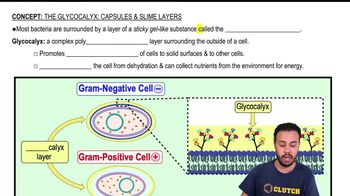
The glycocalyx is a sticky, gelatinous layer composed mainly of polysaccharides that surrounds some bacterial cells. It helps bacteria adhere to surfaces and protects them from environmental stresses. In biofilms, the glycocalyx acts as a matrix that holds cells together and traps nutrients.
Video consigliato:
02:26
The Glycocalyx: Capsules & Slime Layers

Fimbriae and Adhesion

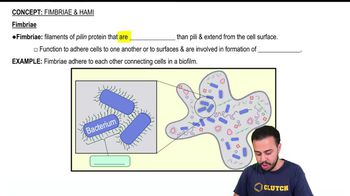
Fimbriae are short, hair-like protein structures on the bacterial surface that facilitate attachment to surfaces and other cells. They play a critical role in the initial stages of biofilm formation by enabling bacteria to stick firmly to a substrate or to each other.
Video consigliato:
01:52
Fimbriae & Hami

Biofilm Formation and Function

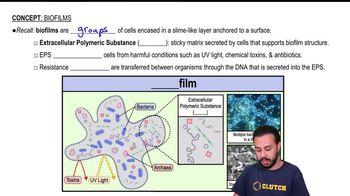
A biofilm is a community of microorganisms embedded in a self-produced extracellular matrix, primarily composed of glycocalyx. This structure provides protection from antibiotics and immune responses, enhances nutrient availability, and allows bacteria to communicate and survive in harsh environments.
Video consigliato:
03:14
Biofilms