
Ch. 5 - Microbial Metabolism
Bauman - Microbiology with Diseases by Taxonomy 6th Edition
Bauman6th EditionMicrobiology with Diseases by TaxonomyISBN: 9780134832302Non è quello che usi tu?Cambia libro di testo
Capitolo 5, Problema 1

How does amination differ from transamination?

Guida verificata passo dopo passo
1
Understand that both amination and transamination are biochemical processes involving amino groups, which are important in amino acid metabolism.
Define amination as the process where an amino group (−NH₂) is directly added to a molecule, typically converting a keto acid into an amino acid by incorporating free ammonia (NH₃).
Define transamination as the transfer of an amino group from one amino acid to a keto acid, resulting in the formation of a new amino acid and a new keto acid; this process is catalyzed by enzymes called transaminases or aminotransferases.
Recognize that the key difference lies in the source of the amino group: amination uses free ammonia, while transamination transfers the amino group between molecules.
Summarize that amination introduces an amino group de novo to a molecule, whereas transamination exchanges amino groups between amino acids and keto acids, facilitating amino acid interconversion.

Risposta video verificata per un problema simile:

Questa soluzione video è stata consigliata dai nostri tutor come utile per risolvere questo problema.
Durata del video:
2m

Concetti chiave

Ecco i concetti essenziali che devi comprendere per rispondere correttamente alla domanda.

Amination

Amination is the chemical process of introducing an amino group (–NH2) into an organic molecule, often converting a carbonyl group into an amine. This reaction can occur through various pathways, including direct amination or reductive amination, and is essential in synthesizing amino acids and other nitrogen-containing compounds.

Transamination

Transamination is a specific enzymatic reaction where an amino group is transferred from an amino acid to a keto acid, forming a new amino acid and a new keto acid. This process is crucial in amino acid metabolism and nitrogen balance, allowing the interconversion of amino acids without the need for free ammonia.

Role of Enzymes in Amination and Transamination

Enzymes play a key role in both amination and transamination reactions. While amination can be non-enzymatic or enzymatic, transamination specifically requires transaminase enzymes (aminotransferases) that facilitate the transfer of amino groups between molecules, ensuring specificity and efficiency in metabolic pathways.
Video consigliato:
02:55
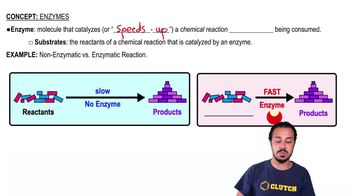
Enzymes
Pratica correlata
Domanda del libro di testo

For the phrase given below, indicate the type of metabolism referred to, using the following choices:

a. Anabolism only

b. Both anabolism and catabolism (amphibolic)

c. Catabolism only


Breaks a large molecule into smaller ones

1255
views
Domanda del libro di testo

Label the diagram below to indicate acetyl-CoA, electron transport chain, FADH2, fermentation, glycolysis, citric acid cycle, NADH, and respiration. Indicate the net number of molecules of ATP that could be synthesized at each stage during bacterial respiration of one molecule of glucose.

1246
views
Domanda del libro di testo

Label the mitochondrion to indicate the location of glycolysis, the citric acid cycle, and electron transport chains.

1089
views
Domanda del libro di testo

Match the descriptions below with their corresponding terms.


1. _____ Occurs when energy from a compound containing phosphate reacts with ADP to form ATP

2. _____ Involves formation of ATP via reduction of coenzymes in the electron transport chain

3. _____ Begins with glycolysis

4. _____ Occurs when all active sites on substrate molecules are filled


A. Saturation

B. Oxidative phosphorylation

C. Substrate-level phosphorylation

D. Photophosphorylation

E. Carbohydrate catabolism

1416
views
Domanda del libro di testo

The final electron acceptor in cyclic photophosphorylation is _________.

66
views
Domanda del libro di testo

For the phrase given below, indicate the type of metabolism referred to, using the following choices:

a. Anabolism only

b. Both anabolism and catabolism (amphibolic)

c. Catabolism only


Includes dehydration synthesis reactions

767
views