Ch. 11 - Innate Immunity
Norman-McKay- Microbiology: Basic and Clinical Principles 2nd Edition
Norman-McKay2nd EditionMicrobiology: Basic and Clinical PrinciplesISBN: 9780137661619Non è quello che usi tu?Cambia libro di testo
Capitolo 7, Problema 3

Which of the following would most directly reduce fever? Select all that apply.
a. Limiting the number of circulating white blood cells
b. Reducing eicosanoid production
c. Inhibiting pyrogenic cytokines
d. Stimulating the action of prostaglandins
e. Administering antihistamines

Guida verificata passo dopo passo
1
Step 1: Understand the biological basis of fever. Fever is primarily caused by the action of pyrogenic cytokines (such as IL-1, IL-6, and TNF-alpha) that stimulate the production of prostaglandins, especially prostaglandin E2 (PGE2), in the hypothalamus, which raises the body's temperature set point.
Step 2: Analyze each option in terms of its effect on fever. For example, limiting white blood cells (option a) affects immune response but does not directly reduce fever.
Step 3: Recognize that reducing eicosanoid production (option b) would decrease prostaglandin synthesis because prostaglandins are a type of eicosanoid, thus potentially lowering fever.
Step 4: Understand that inhibiting pyrogenic cytokines (option c) would prevent the initial signaling that leads to prostaglandin production and fever development, directly reducing fever.
Step 5: Note that stimulating prostaglandins (option d) would likely increase fever, and administering antihistamines (option e) mainly affects allergic responses rather than fever, so these are less likely to reduce fever.

Risposta video verificata per un problema simile:

Questa soluzione video è stata consigliata dai nostri tutor come utile per risolvere questo problema.
Durata del video:
3m

Concetti chiave

Ecco i concetti essenziali che devi comprendere per rispondere correttamente alla domanda.

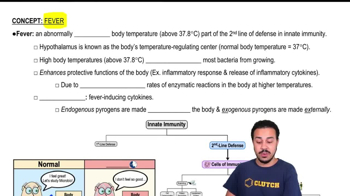
Role of Pyrogenic Cytokines in Fever

Pyrogenic cytokines, such as interleukin-1 and tumor necrosis factor, trigger the hypothalamus to raise body temperature, causing fever. Inhibiting these cytokines can directly reduce fever by preventing the signaling that induces the fever response.
Video consigliato:
03:57
Fever

Eicosanoids and Prostaglandins in Fever Regulation

Eicosanoids, including prostaglandins like PGE2, mediate inflammation and fever by acting on the hypothalamus to increase body temperature. Reducing eicosanoid or prostaglandin production lowers fever, while stimulating prostaglandins promotes fever.
Video consigliato:
03:57
Fever

Function of Antihistamines and White Blood Cells in Fever

Antihistamines block histamine receptors, mainly reducing allergy symptoms but have limited direct effect on fever. White blood cells fight infection but limiting their number does not directly reduce fever; fever is primarily controlled by cytokines and prostaglandins.
Video consigliato:
05:33
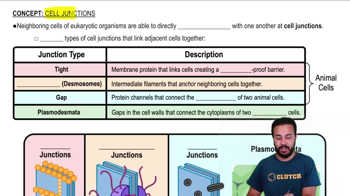
Cell Junctions
Pratica correlata
Domanda del libro di testo

Pick which statements are true, then correct all false statements, so they are also true.

a. Redness, pain, fever, and swelling characterize inflammation.

b. Granulocytes include monocytes and lymphocytes.

c. Pyrogens induce fever.

d. Adaptive and innate immune responses are completely independent from one another.

e. The innate immune responses occur faster than adaptive responses.

f. Monocytes are highly phagocytic cells.

g. Complement cascades share the same outcomes: opsonization, cytolysis, and fever.

1360
views
Domanda del libro di testo

Which of the following would you expect to see in acute infection by a Gram-negative bacterium? Select all that apply.

a. Pyrexia

b. Decreased lymphocytes

c. Neutrophilic lymphocytosis

d. Decreased monocytes

e. Increased release of pro-inflammatory cytokines

1397
views
Domanda del libro di testo

Which of the following would you expect to see increased in circulation in a patient suffering from allergies? Select all that apply.

a.

b.


c.

d.

e.

1373
views
Domanda del libro di testo

Classify each defense as either first-line, second-line cellular, or second-line molecular:

Inflammation

Neutrophils

Skin

Antimicrobial peptides

Lysozyme

Stomach acid

Eosinophils

Fever

Complement proteins

Mucus

Iron-binding proteins

Phagocytosis

1568
views
Domanda del libro di testo

The ____________ cascade of complement activation is initiated by antibodies. In contrast, the ____________ cascade is activated by a direct interaction with complement proteins, and the ____________ cascade is activated by MBL associating with a pathogen.

1317
views