
Ch. 13 - Viruses, Viroids, and Prions
Tortora - Microbiology: An Introduction 14th Edition
Tortora14th EditionMicrobiology: An IntroductionISBN: 9780138200398Non è quello che usi tu?Cambia libro di testo
Capitolo 9, Problema 8

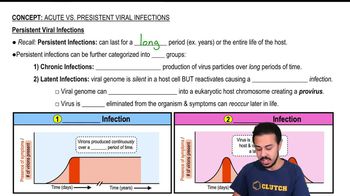
Persistent viral infections such as (a) ________ might be caused by (b) ________ that are (c) ________.

Guida verificata passo dopo passo
1
Step 1: Understand the concept of persistent viral infections. These are infections where the virus remains in the host for a long period, often without causing immediate symptoms, and can evade the immune system.
Step 2: Identify examples of persistent viral infections. Common examples include viruses like HIV, herpes simplex virus (HSV), and hepatitis B virus (HBV).
Step 3: Recognize the cause of persistent infections. These infections are often caused by viruses that can integrate into the host genome or establish latency, allowing them to persist.
Step 4: Define the nature of the viruses causing persistence. Such viruses are typically described as latent or slow-replicating, meaning they can remain dormant or replicate at low levels to avoid immune detection.
Step 5: Summarize the answer by filling in the blanks: (a) an example of a persistent viral infection, (b) the type of virus causing it, and (c) the characteristic of the virus that allows persistence.

Risposta video verificata per un problema simile:

Questa soluzione video è stata consigliata dai nostri tutor come utile per risolvere questo problema.
Durata del video:
3m

Concetti chiave

Ecco i concetti essenziali che devi comprendere per rispondere correttamente alla domanda.

Persistent Viral Infections

Persistent viral infections occur when a virus remains in the host for extended periods, often evading the immune system. These infections can be latent or chronic, causing ongoing or recurring symptoms, as seen in diseases like HIV or herpes simplex virus.
Video consigliato:
05:12
Persistent Viral Infections

Viral Pathogens

Viral pathogens are viruses that cause disease by infecting host cells and replicating within them. Understanding the specific virus involved is crucial, as different viruses have unique mechanisms for persistence and immune evasion.
Video consigliato:
03:40
Introduction to Pathogenic Toxins

Mechanisms of Viral Persistence

Viruses persist by mechanisms such as latency, immune system evasion, or integration into the host genome. These strategies allow viruses to avoid clearance, maintain infection, and sometimes reactivate, contributing to chronic disease.
Video consigliato:
05:12
Persistent Viral Infections
Pratica correlata
Domanda del libro di testo

Which of the following does not initiate DNA synthesis?

a. A double-stranded DNA virus (Poxviridae)

b. A DNA virus with reverse transcriptase (Hepadnaviridae)

c. An RNA virus with reverse transcriptase (Retroviridae)

d. A single-stranded RNA virus (Togaviridae)

e. None of the above

1179
views
Domanda del libro di testo

Place the following in the order in which they are found in a host cell: (1) capsid proteins;

(2) infective phage particles; (3) phage nucleic acid.

a. 1, 2, 3

b. 3, 2, 1

c. 2, 1,3

d. 3, 1, 2

e. 1, 3, 2

946
views
Domanda del libro di testo

Recall from Chapter 1 that Koch's postulates are used to determine the etiology of a

disease. Why is it difficult to determine the etiology of

a. a viral infection, such as influenza?

b. cancer?

1374
views
Domanda del libro di testo

Plant viruses can’t penetrate intact plant cells because (a) ________; therefore, they enter cells by (b) ________. Plant viruses can be cultured in (c) ________.

1396
views
Domanda del libro di testo

A viral species is not defined on the basis of the disease symptoms it causes. The best example of this is

a. polio.

b. rabies.

c. hepatitis.

d. chickenpox and shingles.

e. measles.

1128
views
Domanda del libro di testo

Which of the following statements is false?

a. Viruses contain DNA or RNA.

b. The nucleic acid of a virus is surrounded by a protein coat.

c. Viruses multiply inside living cells using viral mRNA, tRNA, and ribosomes.

d. Viruses cause the synthesis of specialized infectious elements.

e. Viruses multiply inside living cells.

1459
views