
Ch. 13 - Viruses, Viroids, and Prions
Tortora - Microbiology: An Introduction 14th Edition
Tortora14th EditionMicrobiology: An IntroductionISBN: 9780138200398Non è quello che usi tu?Cambia libro di testo
Capitolo 9, Problema 8

Place the following in the order in which they are found in a host cell: (1) capsid proteins;
(2) infective phage particles; (3) phage nucleic acid.
a. 1, 2, 3
b. 3, 2, 1
c. 2, 1,3
d. 3, 1, 2
e. 1, 3, 2

Guida verificata passo dopo passo
1
Understand the life cycle of a bacteriophage (phage) inside a host cell. When a phage infects a bacterial cell, it first injects its nucleic acid (DNA or RNA) into the host.
Recognize that after the phage nucleic acid is inside the host, it directs the host machinery to synthesize phage components, including capsid proteins.
Note that capsid proteins are produced after the nucleic acid is inside the host because the host's ribosomes translate the phage genes to make these proteins.
Once enough capsid proteins and nucleic acid are synthesized, they assemble inside the host cell to form complete infective phage particles.
Therefore, the correct order inside the host cell is: (3) phage nucleic acid, (1) capsid proteins, and finally (2) infective phage particles.

Risposta video verificata per un problema simile:

Questa soluzione video è stata consigliata dai nostri tutor come utile per risolvere questo problema.
Durata del video:
1m

Concetti chiave

Ecco i concetti essenziali che devi comprendere per rispondere correttamente alla domanda.

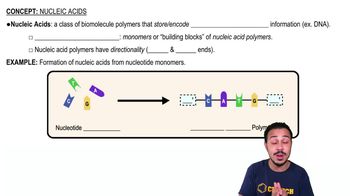
Phage Nucleic Acid Entry

During infection, a bacteriophage injects its nucleic acid (DNA or RNA) into the host cell first. This genetic material carries the instructions for producing new viral components, initiating the replication cycle inside the host.
Video consigliato:
03:22
Nucleic Acids

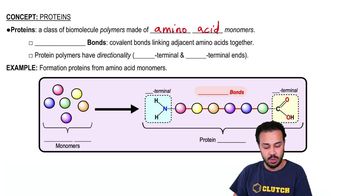
Capsid Protein Synthesis

After the phage nucleic acid is inside the host, the host's machinery synthesizes capsid proteins based on viral genetic instructions. These proteins will later assemble to form the protective shell of new phage particles.
Video consigliato:
02:50
Proteins

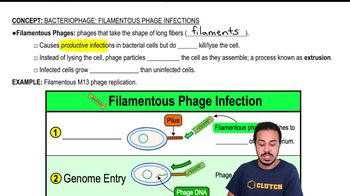
Assembly of Infective Phage Particles

Once capsid proteins and nucleic acids are produced, they assemble into complete, infective phage particles inside the host cell. These mature virions are then ready to be released to infect new cells.
Video consigliato:
04:18
Bacteriophage: Filamentous Phage Infections