
Ch. 14 - Principles of Disease and Epidemiology
Tortora - Microbiology: An Introduction 14th Edition
Tortora14th EditionMicrobiology: An IntroductionISBN: 9780138200398Non è quello che usi tu?Cambia libro di testo
Capitolo 10, Problema 5

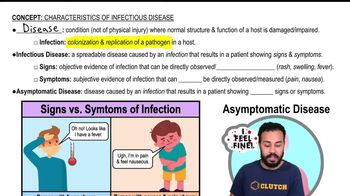
Distinguish symptoms from signs as signals of disease.

Guida verificata passo dopo passo
1
Understand that both symptoms and signs are indicators of disease, but they differ in how they are observed and reported.
Define symptoms as subjective experiences reported by the patient, such as pain, fatigue, or nausea, which cannot be directly measured by others.
Define signs as objective evidence of disease that can be observed or measured by a healthcare professional, such as a rash, fever, or abnormal blood pressure.
Recognize that symptoms provide insight into the patient's personal experience of illness, while signs provide measurable data that can confirm or support a diagnosis.
Summarize by stating that symptoms are patient-reported sensations, whereas signs are clinician-observed or instrument-measured indicators of disease.

Risposta video verificata per un problema simile:

Questa soluzione video è stata consigliata dai nostri tutor come utile per risolvere questo problema.
Durata del video:
3m

Concetti chiave

Ecco i concetti essenziali che devi comprendere per rispondere correttamente alla domanda.

Symptoms

Symptoms are subjective experiences reported by the patient, such as pain, fatigue, or nausea. They cannot be directly observed or measured by others and provide insight into the patient's internal condition.
Video consigliato:
05:09
Intro to Characteristics of Infectious Disease

Signs

Signs are objective indicators of disease that can be observed or measured by a healthcare provider, such as fever, rash, or abnormal heart sounds. They provide concrete evidence of an underlying health issue.
Video consigliato:
05:09
Intro to Characteristics of Infectious Disease

Role in Disease Diagnosis

Both symptoms and signs are essential for diagnosing diseases; symptoms guide the clinician to suspect certain conditions, while signs help confirm and assess the severity of the illness through physical examination and tests.
Video consigliato:
04:57
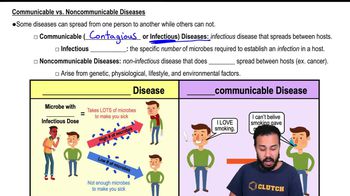
Communicable vs. Noncommunicable Diseases
Pratica correlata
Domanda del libro di testo

Which of the following statements is false?

a. E. coli never causes disease

b. E. coli provides vitamin K for its host

c. E. coli often exists in a mutualistic relationship with humans

d. A disease-causing strain of E. coli causes bloody diarrhea

1169
views
Domanda del libro di testo

Which of the following is not one of Koch's postulates?

a. The same pathogen must be present in every case of the disease.

b. The pathogen must be isolated and grown in pure culture from the diseased host.

c. The pathogen from pure culture must cause the disease when inoculated into a healthy, susceptible laboratory animal.

d. The disease must be transmitted from a diseased animal to a healthy, susceptible animal by direct contact.

e. The pathogen must be isolated in pure culture from an experimentally infected lab animal.

1538
views
Domanda del libro di testo

Which one of the following diseases is not correctly matched to its reservoir?

a. Influenza-animal

b. Rabies-animal

c. Botulism-nonliving

d. Anthrax-nonliving

e. Toxoplasmosis-cats

1398
views
Domanda del libro di testo

Among hospital patients who have infections, one-third did not enter the hospital with the infection but rather acquired it in the hospital. How do they acquire these infections? What is the method of transmission of these infections? What is the reservoir of infection?

1235
views
Domanda del libro di testo

Use the following information to answer questions 6–7.

On September 6, a 6-year-old boy experienced fever, chills, and vomiting. On September 7, the child was hospitalized with diarrhea and swollen lymph nodes under both arms. On September 3, he had been scratched and bitten by a cat. The cat was found dead on September 5, and Y. pestis was isolated from the cat. Chloramphenicol was administered to the child from September 7, when Y. pestis was isolated from his blood. On September 17, the child's temperature returned to normal. On September 22, the child was released from the hospital.

Identify the incubation period for this case of bubonic plague.

a. September 3-5

b. September 3-6

c. September 6-7

d. September 6-17

845
views
Domanda del libro di testo

How can a local infection become a systemic infection?

1312
views